Week 2 – Generative Art

Concept

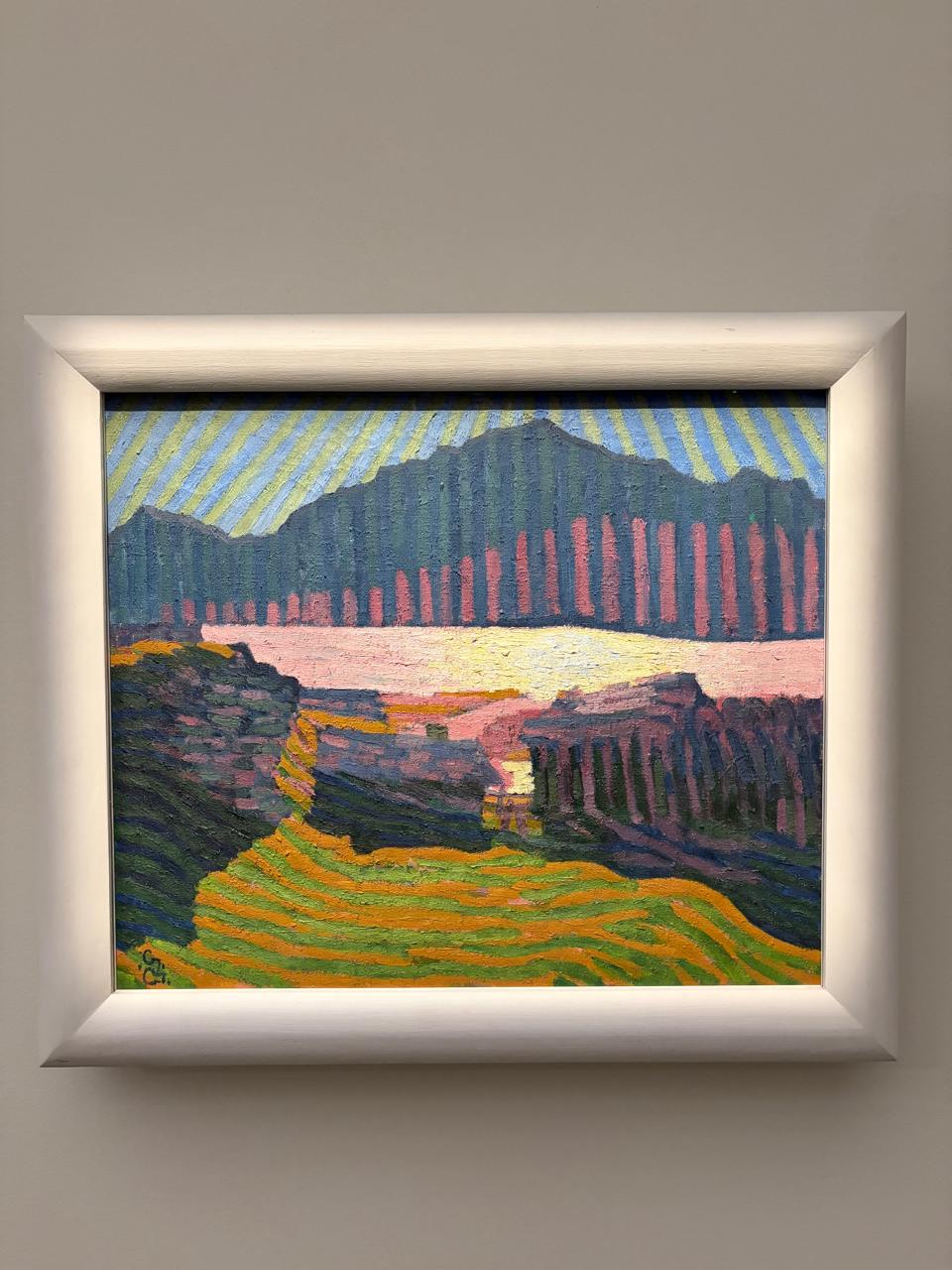
I grew up around my father’s paintings, he is a cubist, so when this assignment asked for a work of art made out of loops, my first instinct was to try and get something of his work into it.

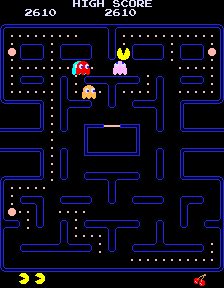
His paintings have a similar touch. An Emirati figure in traditional clothing, but the face is never a face. In one it is a Pepsi cap and a cola glass. In another it is a Jumeira Road sign with a traffic light on top. In a third the whole scene is an arcade cabinet, Pac-Man and Space Invaders. The body stays traditional and the head is always something imported. That contrast is the thing I wanted to borrow.

What I ended up making is a hand doing the three fingers salute that H.H Sheikh Mohammed bin Rashid does three fingers up for win, victory and love. The whole canvas is broken into irregular shapes that slide up and down against each other, the way a cubist face is broken into planes that do not line up. The hand is made of exactly the same shapes as the background, so most of the time you cannot see it at all, I also got inspiration from one of the sources to create an illusion effect with the hand and implemented it.

Then it comes out. And as it appears, it also stops moving. Everything around it keeps sliding but the hand holds completely still. It is the one fixed thing in a field that never settles. Then it fades back in and rejoins, and comes back in the next color of the flag; red, then green, then white, then black.

Code Snippet

quad(
       x + random(-j, j), y + random(-j, j) + d,
       x + s + random(-j, j), y + random(-j, j) + d,
       x + s + random(-j, j), y + s + random(-j, j) + d,
       x + random(-j, j), y + s + random(-j, j) + d
     );

This part of the code is where I was most proud of, creating those irregular shapes and making that motion of sliding against each other with the slide function, it took time and effort searching through references and working with the p5.js tutorials but I was finally able to get it. The quad() is what makes the shapes look shattered instead of like a grid. If you take out all four random() calls you are left with the plain corners of a square: x, y then x+s, y then x+s, y+s then x, y+s. Adding a small random nudge to each corner is the entire difference between a pixel grid and something that looks like a broken plane. That was the closest I could get in code to how my dad breaks a face into flat angled pieces.

Embedded Sketch


How This Was Made

This was made with a lot of references that were new to me. Most of them came from the p5.js reference site, where I found quad(), noise(), randomSeed(), lerpColor(), constrain(), and abs(). Each one ended up doing a specific job.

. quad() is what let me draw a four sided shape with corners anywhere I wanted, instead of rect() which is always a right angled box. Without it there is no fractured look at all.

. noise() gave me smooth randomness rather than the jumpy kind, so neighbouring facets get similar colours and the background reads as planes instead of static.

. randomSeed() solved a problem I did not see coming. The shapes flickered violently until I understood that random() runs fresh every frame, and resetting the seed at the top of draw() makes every facet keep the shape it had.

. lerpColor() mixes two colours by a proportion, which is what lets the hand fade out of the background rather than being switched on and off.

. constrain() clamps a number between two limits. I used it to flatten the top and bottom of the sine wave so the hand holds still at each end instead of permanently mid fade.

Reflection and Future Work

The thing I did not expect is how much of the piece is decided by numbers rather than by drawing. I never drew a hand. I wrote six conditions and tuned numbers until the silhouette matched a photo. That felt strange at first and then it felt like the point.

It also lined up with the Reas talk more than I thought it would. The shapes are random, but I chose the palette, the grid size, how far a corner can wander and how fast the fade runs. The randomness does the part I could not be bothered to do by hand, and it produces small irregularities I would never have thought to draw. That is the balance he was talking about.

For the future, I would use the mouseX to control how far the shapes wander, so the viewer decides how broken the image is, make the hand disappear in a better fade look than just fade without a proper effect.


Week 2 – Reading/video Response

Casey Reas’ talk about chance operations made me think about the relationship between control and power. One example that stood out to me was the massive structure he talks about called “Homage to New York” that was designed to destroy itself through a performance. The structure ended up catching on fire, which was not completely expected, but I found this interesting because the idea behind the work came from the Atomic Age and the huge amount of power that machines and technology can have. It made me think about how we react to things that we create but cannot completely control.

(Homage to New York by Jean Tinguely)

He also mentioned the mistrust of machines and systems of power which i found interesting. Machines are usually made to create order and follow specific rules, but they can also create chaos when something unexpected happens. There’s also a difference between the person creating the system and the machine following through with it. We can give machines instructions but we can’t always predict exactly what will happen. This makes me question how much control we should give machines (especially Ai nowadays), especially when they are connected to systems of power that can affect people.

I also liked the contrast between drawing by hand and making art through a computer. When I draw something myself, it feels more personal because I am controlling every line and decision. With a computer, I can create the rules but then allow chance to take over some of the decisions. For my updated p5.js self-portrait , for example, I learned how to create a set palette of colors and let the computer randomly choose a color whenever I click. I would still control the choices and the overall design, but I would not completely control the final result.

For me, the best balance is somewhere between complete control and complete randomness. I still want my work to feel intentional and personal, but I think adding chance can make it less predictable and more interesting. Reas’ talk changed how I think about randomness because I used to see unexpected results as mistakes. Now I see that they can become part of the artwork itself. It also leaves me wondering how much control an artist should give up and whether a machine can become part of the creative process without taking away the personal side of making art.

Week 2 – Reading Reflection

Casey Reas’s talk really changed the way I think about randomness in art. Before watching it I mostly thought of randomness as something that takes away the artist’s control and gives freedom to the computer  but I now see that randomness can still be intentional when the artist creates the rules and limits first. What interested me most was how Reas showed that order and chaos can exist together. The biological pieces especially stood out to me such as the representations of proteins, cancer cells and tissue. Computer vision was being used to visualize things that would normally be strange or difficult to represent visually but the results became these beautiful organic forms. I was particularly drawn to the pieces made from long lines that curve and build into cirI was also interested in how the same idea of randomness could be used in completely different fields, from biological structures to fashion, vehicles, music and movement. It made me think of how something that looks chaotic can still convey a certain feeling or idea if the artist has created an underlying structure.

The talk also made me question where I personally want the balance between randomness and control to be. I do not think that more randomness automatically makes a piece more interesting. If everything is random, I feel that the work can become visual noise and lose the artist’s intention. For me, the most interesting point is when the artist controls the concept, structure and limits, while the computer controls smaller decisions within those boundaries. I never thought such a simple coding function could create art at a technical level. I now see code more like an artistic medium similar to paints where the artist can set the rules and allow the system to produce something unexpected. Reas’ examples of random numbers and the idea of making small changes that create chaos in an ordered way also made me think about how even very small variations can completely change an outcome.

For my production project, I think I want to explore this idea through the biological-inspired visual art. The pieces with the long, flowing lines that formed these organic structures were probably what interested me the most because they reminded me of something alive and gave me this feeling of freedom and flow. I want to try creating something similar where I have control over the overall structure, but I don’t control every little detail. For example, I could use randomness to decide the direction, length, color or movement of the lines. I think that would make the process more interesting because I would still have an idea of what I want the piece to feel like but I would also be able to see what the computer comes up with on its own.

Week 2 – Reading Reflection

Reflection

Casey Reas talk reframed how I think about the role of randomness in creative work. He talks about “controlled randomness,” where the artist doesn’t control every outcome, but does control the rules that the randomness has to follow. So chance is not a lack of decisions, it is just a different kind of decision.

For my own work, I plan to use randomness with some control to make things feel more realistic. I think that too much randomness can make a piece feel meaningless, since it can look like nothing was actually decided or planned before the project. But too much control isn’t great either because it only leaves room for what I’ve already imagined and nothing more.

I don’t think there’s one fixed balance between randomness and control because it really depends on the piece someone is working on. Some ideas need more structure with just a little randomness added in, while others can handle a lot more chance. For me, I would aim to keep the overall rules consistent, but let the small details  like position or timing  be randomized enough to surprise me.

Reading Reflection – Week #2

I like to think of art as a trained lion: tamed enough to be obedient to commands, but still carrying that uncertainty of when it can pounce on you. This is why I was initially skeptical when I first heard about having to create a digital artwork. I thought that involving a computer would strip away the humanness, the emotional weight, that art is supposed to carry. Casey Reas’ talk challenged that assumption of mine. At the beginning of the video, he explains, “The goal…was to make things that are artificial and still had an organic quality to it and try to spot the difference in between” (03:36). This was when I got a glimpse of what this meant. Involving a computer does not necessarily trivialize the thought process of an artist, but can instead act as a medium for creating randomness (or, in the language of my metaphor, the fear of the lion’s pounce). It is indeed that very balance of the artist navigating chance to decide how something should feel that makes coded art legitimate art. I believe Cage would agree, considering his critique as highlighted by Reas: “Those involved in the composition of experimental music find ways and means to remove themselves from the activity of the sounds they make” (16:27).

Even work built on chance still demands that the artist make consequential decisions that shape its direction. For instance, Reas himself claimed to have spent months developing a composition before writing a single line of code. This is what mainly convinced me to move past my preconception and actually appreciate the artistic possibility and the hard work behind coded artworks. Reas’ point near the end about symmetry, about how it taps into the “basic pattern recognition we have in our heads” (28:21), struck me. I did not think that there would be room for imagination in a coded output. Therefore, I am convinced by Reas that the play of structure and randomness is at the core of digital art. However, I still wonder what that balance should actually look like. What level of order and how much chance are to be employed remains very subjective. I do not think this is a flaw in his argument, but rather that it encapsulates what makes an artwork original.

Reading Reflection Week 2

One way that I would like to incorporate randomness into my work is by allowing some visuals to change independently while keeping the main elements under my control. What interested me most about Reas’ talk was how some aspects of the composition can be left to the computer to randomly generate, resulting in the creation of distinctively unique artwork. For example, I could control the main shapes and structures while leaving other aspects like color and size to the computer. This would allow different versions of the artwork to emerge while keeping my original intentions.


For me, I believe that there needs to be an equal mix of artist input and randomness. Total randomness could produce interesting results but would tarnish the original intent of the artist and make it less meaningful. Complete control could also feel bland, as the human imagination can only go so far. Randomness can create new ideas and maybe set some new trends in the digital art world, though keeping it at bay is also important. I think the best balance is giving the computer enough freedom to create something unexpected while still allowing the creator to shape the general direction of the piece.

Week 2 – Generative Art

My concept
Of all the things we were shown in class, the moment in which I felt the most intrigue came from the showcase of colors moving using the mouse. The idea of movement changing the artwork got me really excited, and I dove straight into trying to find a way to do that with some code. Sure the assignment itself required randomness to be used, but the idea of having randomness be controlled, both human and machine working in tandem to make something new, was really interesting to me!

For inspiration I went ahead and looked at computer generated art examples and ended up picking this piece in specific.

As said here, in this art piece, one form is transformed into another. I wanted that element to be an aspect of the art I made. Your input transforms the piece into something else. Though in my case, I wanted the input to be due to color rather than changing the shape of the piece. For my inspiration of that, I looked at movies I watched, and decided on one particular scene from the first  Spider-verse movie.

In this scene, the animators showcase the main characters switch in his story through colors. We understand at this point that the character of Miles Morales is officially on the road to becoming, well, Spider-man (as seen by the blue and red colors). I wanted my piece to have that complete flip from ordinary colors to something bright and flashy. Just so that I could get the same type of excitement from the change in colors.

A highlight of some code that I’m particularly proud of

for (var x = 5; x <= width; x = x + 50) {
  for (var y = 5; y <= height; y = y + 50) {
    fill(0, random(255), mouseX); //green is random, blue is dependent on the x-value of the mouse
    rect(x, y, 25, 25);
  }
}

I’m honestly surprised I even understood how to do a nested loop, and what exactly were the parts I put inside the blank [for ()]. The video I watched  showed a ‘while’ loop first then crunched it all up in a ‘for’ loop, which made me pretty confident when it came to writing this particular loop. Additionally, I didn’t have to search anything up to do the mouseX & mouseY thing to do the colors. I tried it out and was shocked it worked out! So I was really happy about that.

Embedded sketch

‘How Was This Made’ section 

Like 99% percent of this was made because I watched a ton of ‘The Coding Train’ videos. It was recommended to watch the 4 videos about functions, but I went ahead and watched lessons 4, 5, and 6 just in case. I didn’t want to use any AI to figure it out, so I forced myself to learn from the videos. The specific video that helped the most were:

2.5 The random() Function

4.1 while and for Loops

4.2 Nested Loops

5.2 Function Parameters and Arguments

Other than, the rest came from trial and error. I would switch the colors around, change the frame rate (which I learned from class), tried to figure out how I wanted the mouse to play into the piece (it was originally a mouseClicked function), and so on.

Reflection and ideas for future work or improvements

I really wanted to add a mouse click function! And also wanted to make it so that the colors only changed for like 4-5 squares surrounding the mouse. I found a video showcasing how to draw with the mouse, but couldn’t figure out how to do exactly what I wanted, which was unfortunate. But I at least understood (through much trial and error) why I couldn’t do the feature I wanted to add. I also think I’d like to add a bit more variety in the piece, rather than just having the color change be a feature.

Week 2 – Reading Reflection

Reflection:

After watching Casey Reas’ Eyeo talk, I found it very close to my own thinking. I grew up with an artist as a dad, and not just any artist, a cubist. What is cubism, you may ask? It’s a unique and funky type of art that blends different shapes and can be read differently depending on the angle you look at it from. The kind of cubism I grew up seeing also packed ideas, experiences and emotions into a single painting, leaving the viewer to guess what is going on and to find an angle nobody else had found.

That shaped how I look at art. My dad used to bring his work home and make me guess what was happening in it, so I learned to read a painting emotionally and from a perspective different from everyone else’s. This is why the talk resonated with me: art is not cold or unemotional. Every piece carries its own meaning and its own way of thinking about how the artist wanted it to reach people. What’s funny is that sometimes I would see something in his work from a perspective he hadn’t considered himself, and that is exactly what makes it beautiful.

I intend to use randomness to give my work the spark it needs. Random motion in one of the shapes, or a sudden loop of shapes overlapping the piece, could make it better than it already was. It would also create a kind of illusion, pushing viewers to think more deeply about the work instead of just staring at a controlled image, and having the viewers look at my art at different angles.

As for the balance between randomness and control, I don’t think it’s something to stress over. Writing the code is the same exchange I grew up watching: you set the rules the way my dad set his shapes, and what comes out can still surprise you, just as I sometimes found things in his paintings he had never intended. Control gives a piece the stamp of the artist’s own style, while randomness can push it somewhere nobody imagined. A piece can look like it only has one way of being seen, but the beauty comes from people finding perspectives the artist never did.


Week 2- Reading Reflection

The idea of randomness in art is an interesting concept. On one hand, art in itself does already incorporate random elements (ex. watercolor painting). On the other hand, computer art and algorithms provide a new kind of ‘randomness’. You are pretty limited in what kind of artworks you can do in code, but the code you do make you tend to have a good amount of control over. The random elements in the code have to be inserted by your hands.

In that case, how much of the piece is true randomness and chance? How much of the piece comes from your own hand, and how much of it comes from the machine?

These two questions showcase my main worry when approaching randomness in art. I personally tend to agree with Rosalind Krauss’s critique of grid art. “It is not just the sheer number of careers that have been devoted to the exploration of the grid that is impressive, but the fact that never could exploration have chosen less fertile ground.” When Casey Reas bring this quote up, they explain Krauss’s stance against this type of art. “She sees it as the moving away from humanity, moving away from the narrative, and basically making art of its own, rather than our largest intellectual and social discourse.” This art moves away from humanity and becomes its own thing.

I find myself agreeing with this idea, because when art is considered to be random, how much of the art is of the artist and how much is it of the machine? Is it all the artist because the artist is the one typing the code, and controlling what parts of it is random and what isn’t? Or is it the machines’ because the machine brings in the most crucial element of the art– the random aspect of it.

With all that being said, I’m not against the idea of randomness in this sense. I do think that there is still a human hand in the process when creating art such as this. There is still intent in the piece, there is still effort, and there is still discourse to be said about it. My thoughts are just a bit too complicated, and I don’t have an exact answer to the question. I find myself critiquing this art but also not having that big of a problem with it.

When I approach my piece, I honestly want the random elements in my work to be limited. I don’t want my piece to get away from me, it still needs to be my piece. That thought alone implies there needs to be a certain balance between randomness and control in this kind of art. What that would be I am not sure, since despite my worry over control in art, of all the pieces in the reading, I did not at any point think a piece could not be considered art. Maybe its because of intent, or maybe it is because the act to make art is in itself, the best showcase of humanity.

Week2–video reflection

For me, I feel that every artwork needs to represent something that the artist wants to express. An artwork should communicate an idea or feeling.Therefore, I do not want randomness to decide what my work is trying to express. Instead, I want randomness to help me decide what my work looks like.

For example, when I am creating a project, I can first decide what I want to express and what kind of overall atmosphere I want the work to have. Then, I can use randomness to control certain elements, such as shapes, lines, or color. In this way, randomness is not replacing my creative decisions. Instead, it helps me discover forms that I might not have thought of on my own.

As for the optimal balance between randomness and control, I think it is difficult to define. I do not think a 50/50 balance is necessarily the best one. It depends on the final form of the artwork and on how much randomness the artist wants to allow. In other words, I think the important question is not how much randomness we use, but how much of the final result we are willing to give up control over.

I also think randomness can help us discover things we did not know we liked. randomness can produce a result that we did not  choose at first. When we see that unexpected result, we might actually like it. In this sense, randomness expands the possibilities we can choose from.