
The concept
Coming into the midterm project, I had zero ideas about what I wanted to do. While looking for inspiration, I came across a Save the Ocean https://intro.nyuadim.com/2023/03/08/midterm-project-save-the-ocean-game/ game made by a prior student which really inspired me. I really liked the ocean aspect because one of my favourite games growing up was Sky Whale, and I felt like that resonated with me. I wanted to create something that had a playful, game-like feeling while also being connected to something I personally enjoy. I have always loved the ocean and the beach, and even my phone and iPad wallpapers are beaches so I knew I wanted my project to be underwater and ocean-oriented.
I then wanted to connect this idea to Emirati culture and the UAE’s history. I wanted my project to explore what the UAE’s economy looked like before oil, particularly the traditional pearl-diving industry. Before the discovery of oil, pearl diving was an important part of the region’s economy and supported many families. I wanted to show what this traditional activity was like and how difficult and humble the process was. Divers did not have the equipment that modern divers have today. They would spend months away from their families on pearl-diving boats, with some ships carrying around 100–120 people depending on their size. Divers could go down to depths of around 7–30 meters and had to navigate and understand the ocean without modern technology. The experience was also unpredictable because weather and sea conditions could change quickly making pearl diving extremely dangerous.
I also wanted to include some of the cultural elements surrounding pearl diving rather than focusing only on the diving itself. For example, the nahham or traditional ship singer, would sing and chant to motivate the divers and sailors, helping distract them from fatigue during the long journeys. I want to incorporate recordings or recreations of these traditional songs and chants into the game.
Start Screen and Instructions
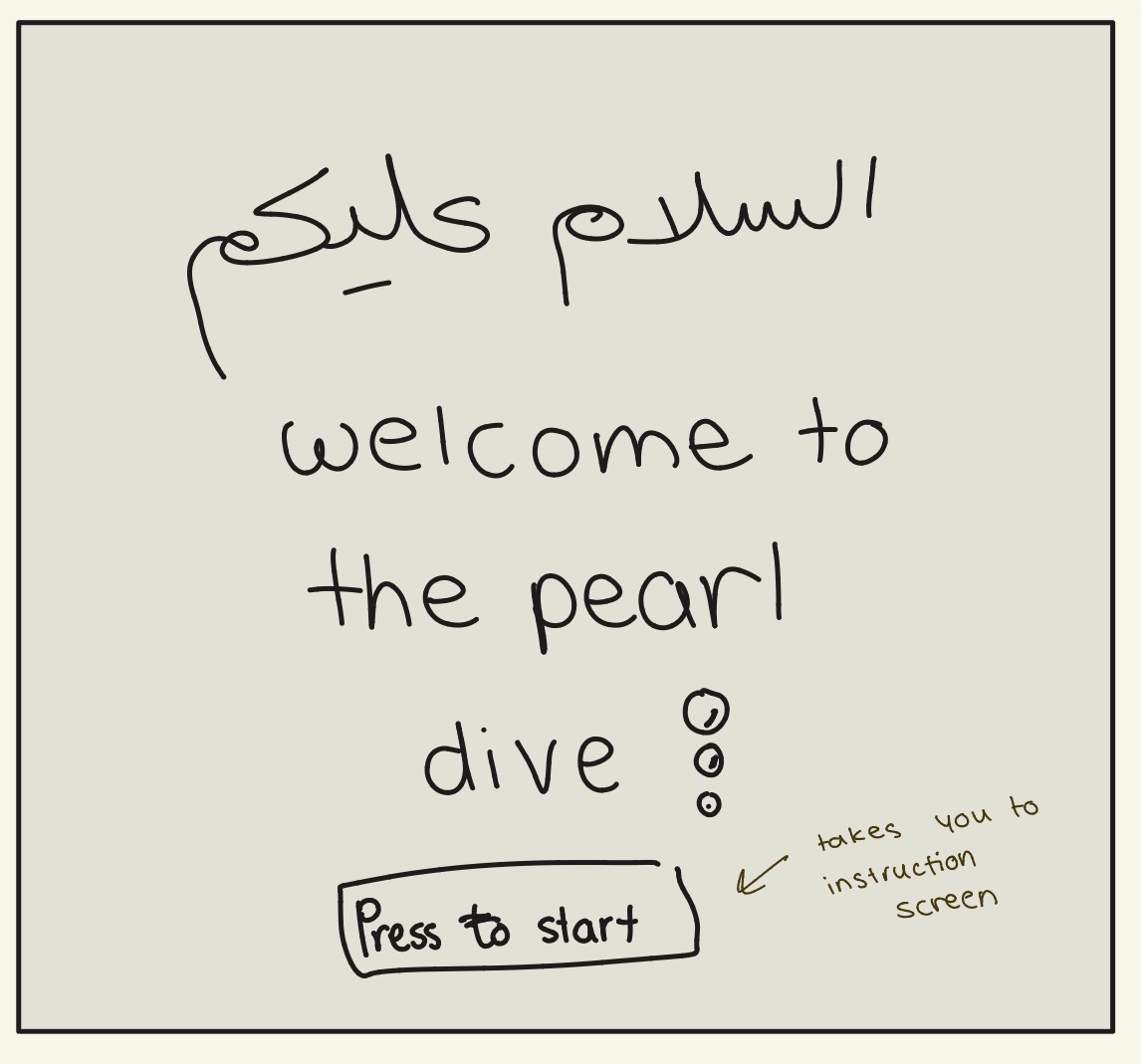
The first sketch shows the starting screen of the game. It will be very simple and will say: “Salam Alaykum, Welcome to the Pearl Dive” The user will then press a Start button, which will take them to an instruction screen explaining how to play the game and what they need to do. After reading the instructions the player will enter the main game.
Main Game Interface
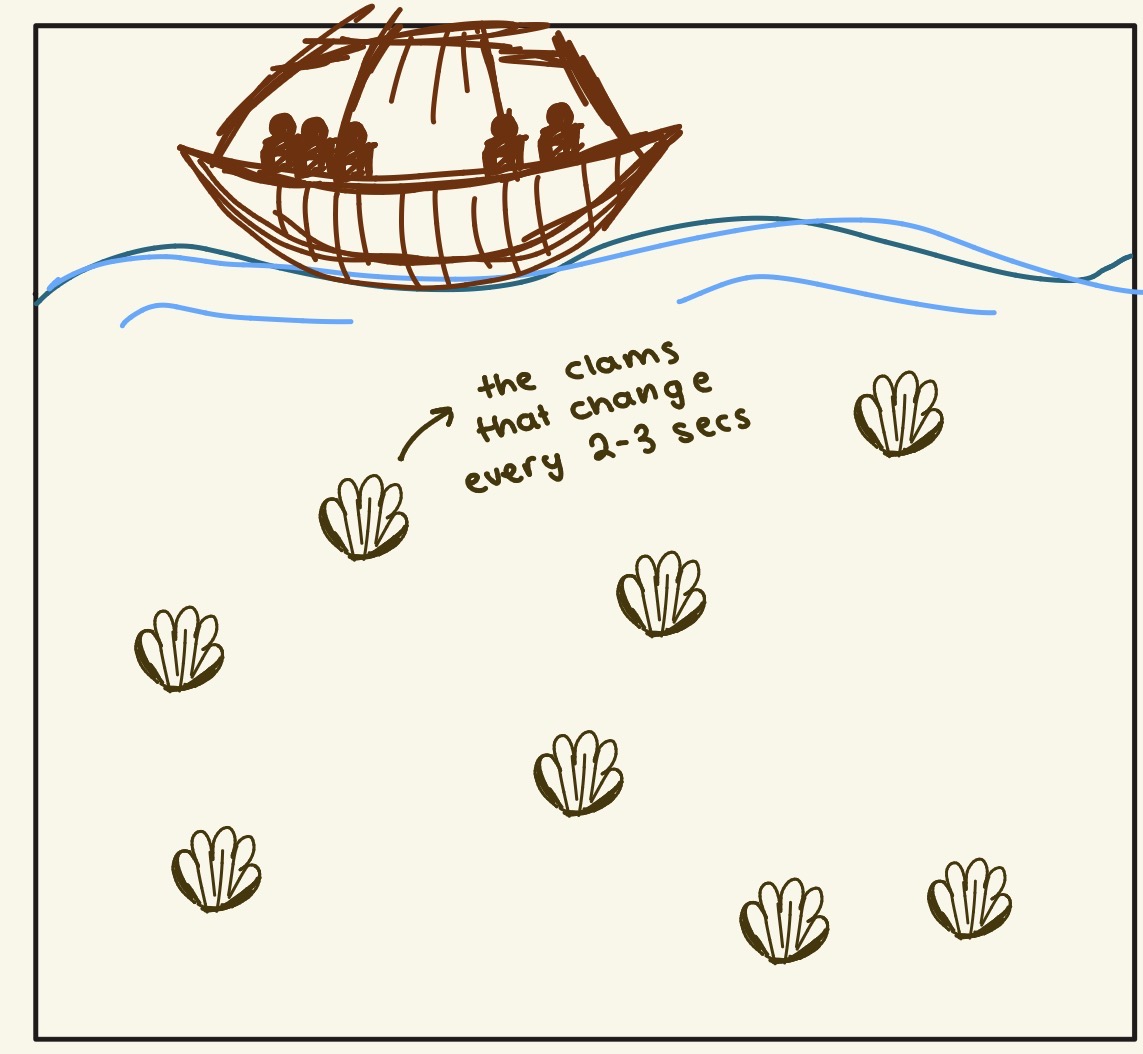
The second sketch shows the main game interface. At the top, there will be a pearl-diving boat, followed by the surface of the ocean. Underwater, there will be clams that the diver has to collect. The clams will regenerate every 2–3 seconds. This is meant to represent the unpredictability and difficulty of pearl diving. Conditions at sea could change quickly, with periods of strong wind or difficult weather making the dives more dangerous. I want to represent this difficulty through the randomness of the clam spawning rather than simply making the game progressively harder. The player will control the diver underneath the boat and will need to collect the clams before they run out of time underwater.
Game Mechanics and Cultural Elements
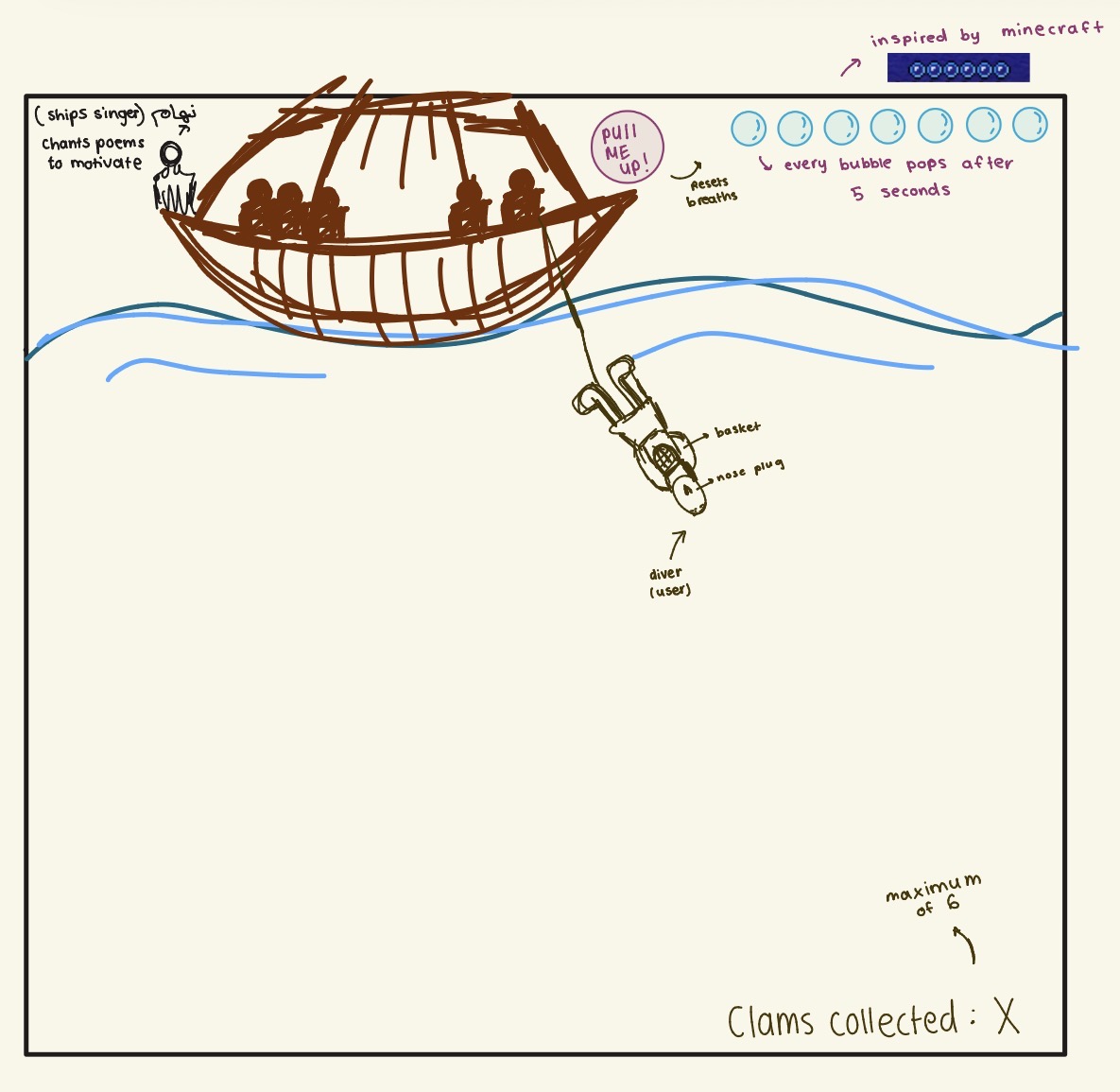
On the boat, there will be a nahham, the traditional ship singer. He will sing traditional songs and chants to motivate the sailors and distract them from their fatigue. I am planning to look for recordings or examples of traditional nahham songs and potentially use an old recording or recreate the audio for the game. I also want to incorporate Islamic-inspired chants/nasheeds where appropriate. On the top right of the screen, there will be seven bubbles representing the seven emirates. Similar to the underwater timer in games like Minecraft, the bubbles will represent how long the diver can remain underwater. Each bubble will disappear after approximately five seconds. Next to the boat, there will be a “Pull Me Up” button. The player can press this button at any point to bring the diver back to the surface, but they must do so before all seven bubbles disappear. The diver himself will also reflect the traditional pearl-diving process. He will have a rope around his neck, a basket for collecting oysters, and a nose plug. He will then dive underwater to collect the clams. At the bottom right of the screen, there will be a clam counter showing the number of clams collected. The maximum will be six clams. Once the player collects all six, they will move on to the pearl auction.
Pearl Auction
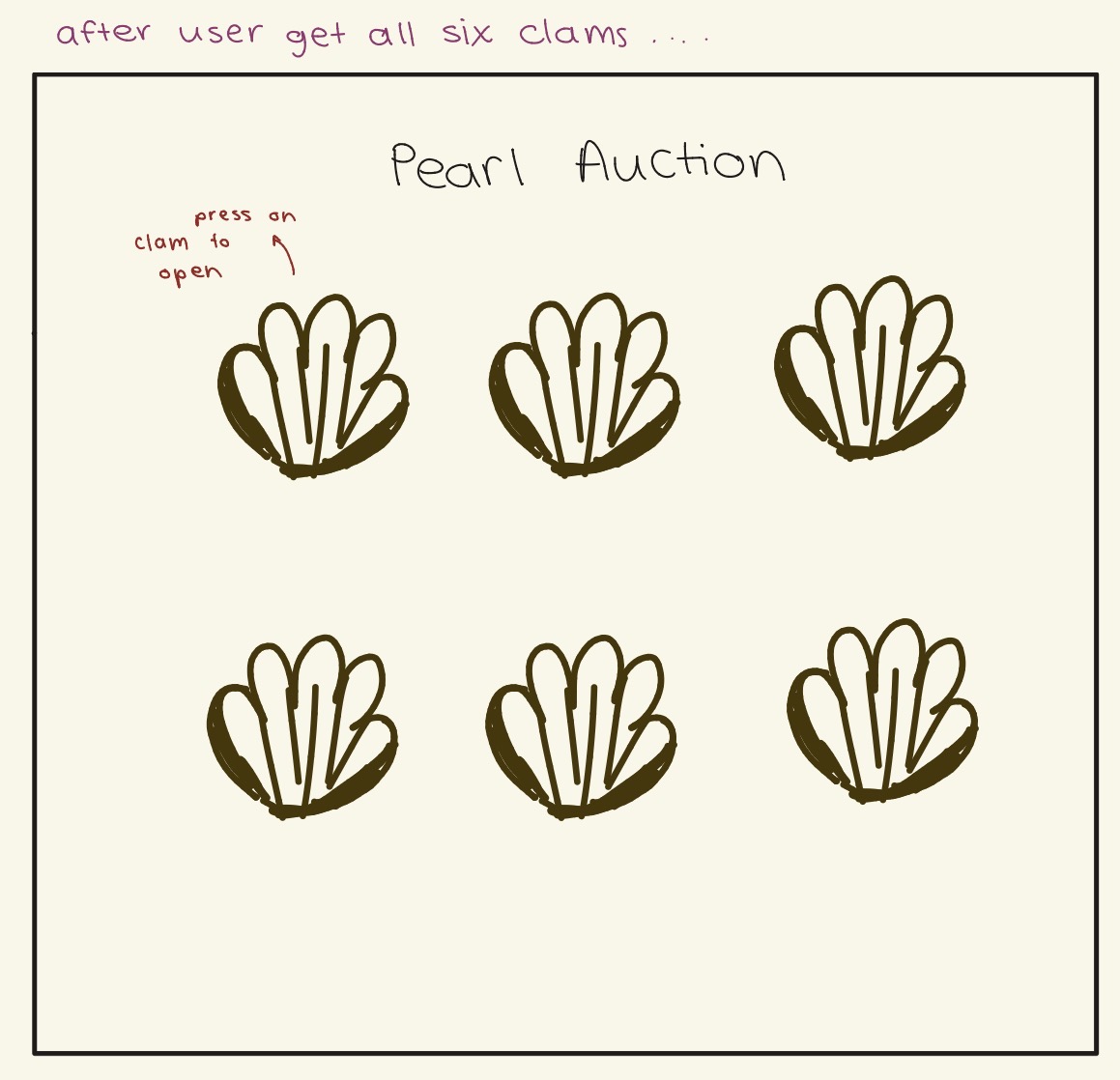
Once the player collects all six clams, the game will transition to a Pearl Auction screen. The screen will have “Pearl Auction” as the title, with the six collected clams displayed underneath in a 3 × 2 layout. The instructions will tell the player: “Press on a clam to open it.” When the player clicks on a clam, it will randomly reveal the weight/size and colour of the pearl inside. The different pearl characteristics will determine its value. The pearl colours will include traditional and rarer variations such as pearly white, slightly pink and grey, with each colour having a different value. The weight of the pearl will also affect its price, with heavier pearls being more valuable. This will introduce a random element to the auction and show how the value of the pearls could vary.
That’s my game so far as of now I don’t know what to do with the value of the pearls, As I’m trying to make the value of the pearl be an interactive element to the game!
For more knowledge on the history:
https://www.facebook.com/watch/?v=24292573663712195
My Project so far
Most Frightening / Uncertain Part
The part of my project that I am most uncertain about is the pearl auction and how the value of each pearl will work as an interactive element. I know that I want the player to open each clam and receive a pearl with a randomly generated size, weight and colour, but I am still figuring out how these characteristics should affect the value of the pearl. I also want the auction to feel like an actual part of the game rather than just showing the player a random number. Another concern is making sure that the random generation feels balanced. If the valuable pearls appear too often, the game will become too easy, but if they are too rare, the player might feel like their score is based completely on luck. I therefore want to test different combinations of pearl colours, sizes and weights and see how they affect the final value.
What I Did to Reduce the Risk
To reduce this risk, I started testing the random generation of the pearls in p5.js. My goal is to have the game randomly generate the characteristics of each pearl when the player opens a clam. For example, the pearl could randomly receive a colour and a weight, and these two characteristics can then be used to calculate its value. I am testing the idea of giving each pearl colour a different base value and then adding to that value depending on the weight of the pearl. This gives me a simple system that I can adjust as I continue developing the game. I can also test the random results multiple times to make sure that different pearl values appear and that the player has a reasonable chance of getting both common and rare pearls. This is important because the pearl auction is one of the main interactive parts of my game. By testing the randomization and value calculation now, I can make sure that the system works before I build the rest of the auction interface around it.