
Original video: https://vimeo.com/45851523
Quotes and ideas referenced from the video comes with a timestamp in purple: (MM:SS)
When I first started making things in code…every line of code was precisely determined by myself and it produced something exactly as I wanted it to be.
– Casey Reas, (0:22)
I connect to this so incredibly well and in fact, it’s quite visible in my Week 2 assignment (hehe). I feel like randomness and chaos often comes with the feeling of “uncontrollable mess” which is intimidating. However, after watching this video, I have the impression that with art, perhaps randomness can produce what is beyond (and even better than) my imagination.
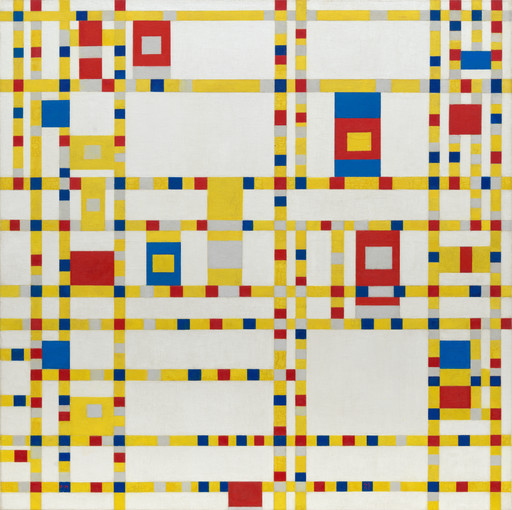
One of the most eye-opening and interesting facts I learned from the video is on Piet Mondrian’s grid paintings. I’ve come across these so many times, and they look like one of those “anyone can do that” paintings at first. I, personally, felt emotionless every time I saw them, so I was surprised when Reas said that these paintings contain brush strokes of “emotional, human-quality (21:54).” I learnt that Mondrian was indirectly inspired by boogie-woogie music, a repetitive, persistent, and repeating bass on the piano.
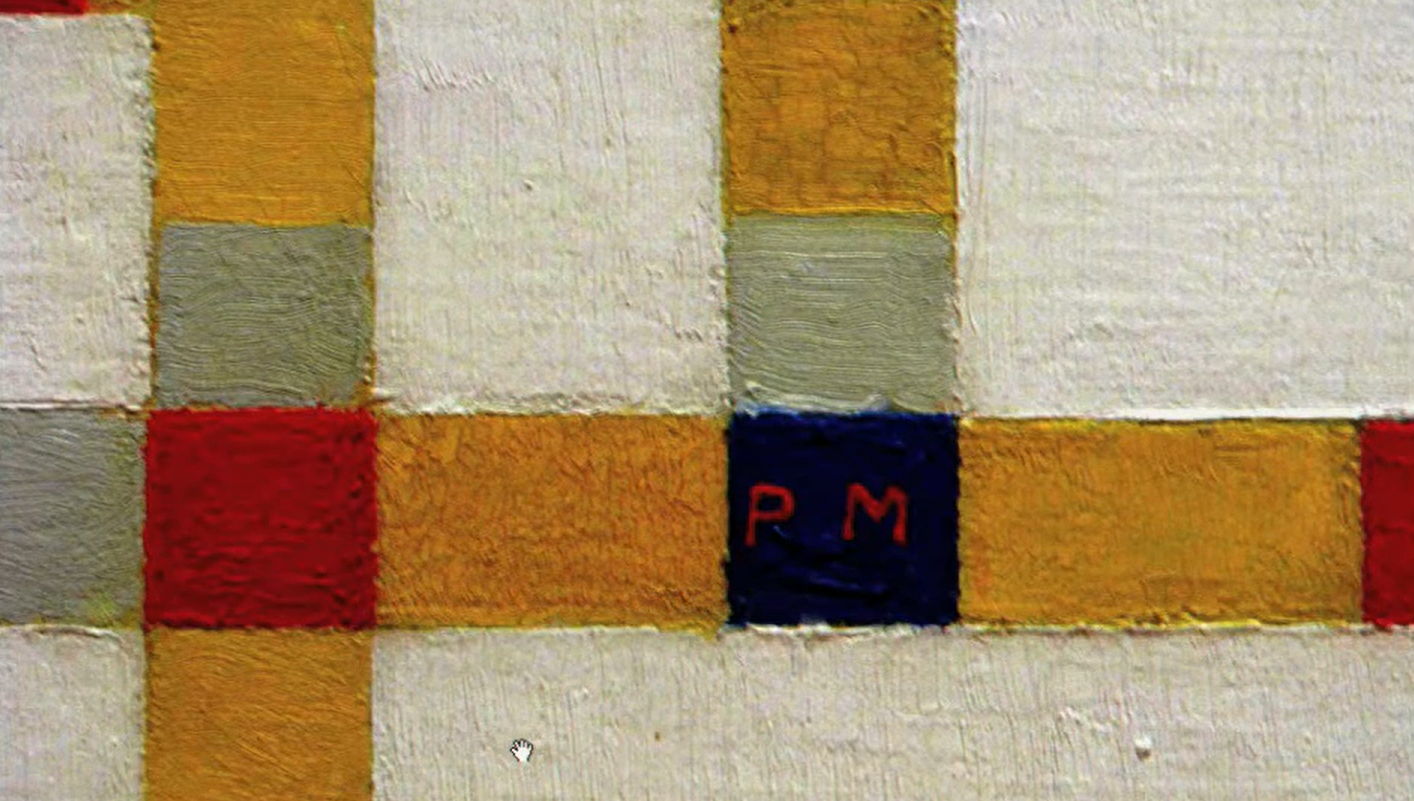
Yet, if looked closely in person, one can notice the visible and thick brush strokes, and the wobble at the edges of the line (21:10). When I learned that Mondrian did not use masking tape for clean edges and wanted to, instead, retain the human texture, my view of his grid paintings completely changed.
Listening to the lecture also reminds me of something I was told as a kid: that real artists don’t use erasers, rulers, or drawing compasses. I never really understood why, but as a child, I thought that it’s because professionals don’t make drawing “mistakes.” After this video lecture, I’m reminded that art is more about embracing humanness, the imperfections, the nuanced and delicate strokes.
Above all, it’s never a blind chance; it’s a chance that is always planned but also always surprising.
– Gerhard Richte (18:30)
On to the guiding question of “where is the optimum balance between total randomness and complete control,” I think it’s difficult and arguably impossible to come up with the “optimum balance,” since it varies by artists and what they’re comfortable with. However, with me personally, I think incorporating random elements would certainly add some “spice” to my work, as it provokes curiosity and excitement. Some of the ideas I came up with ironically involve controlling the randomness:
- Random combinations of colors from a list/array of colors that are on-themed.
- Shapes/elements appearing/moving at random coordinates/speeds within the canvas boundaries
- Random number of shapes/elements but there is a lower limit and upper limit.
This way, I can have some “randomness” within my sketch without making them total chaos.