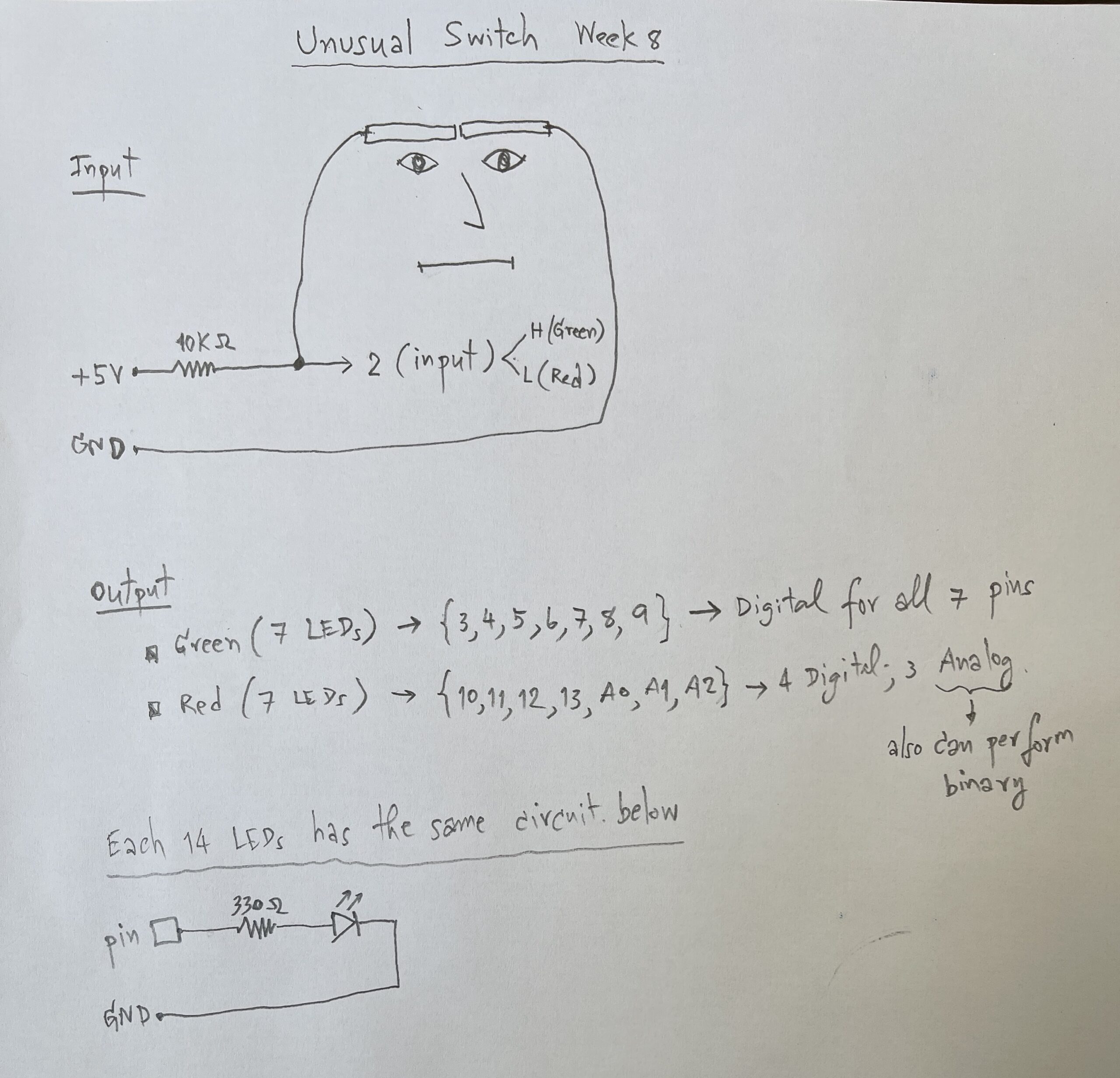
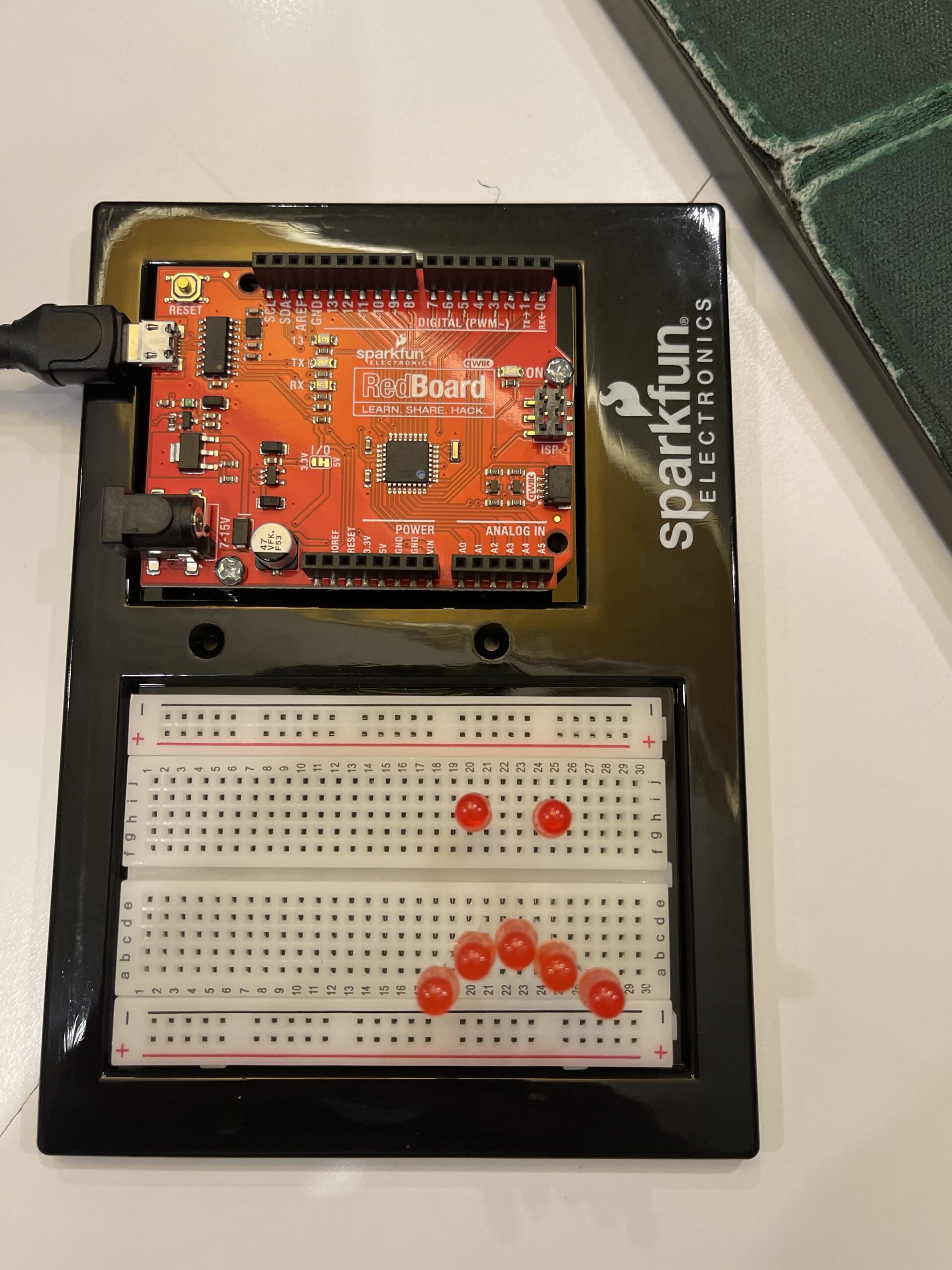
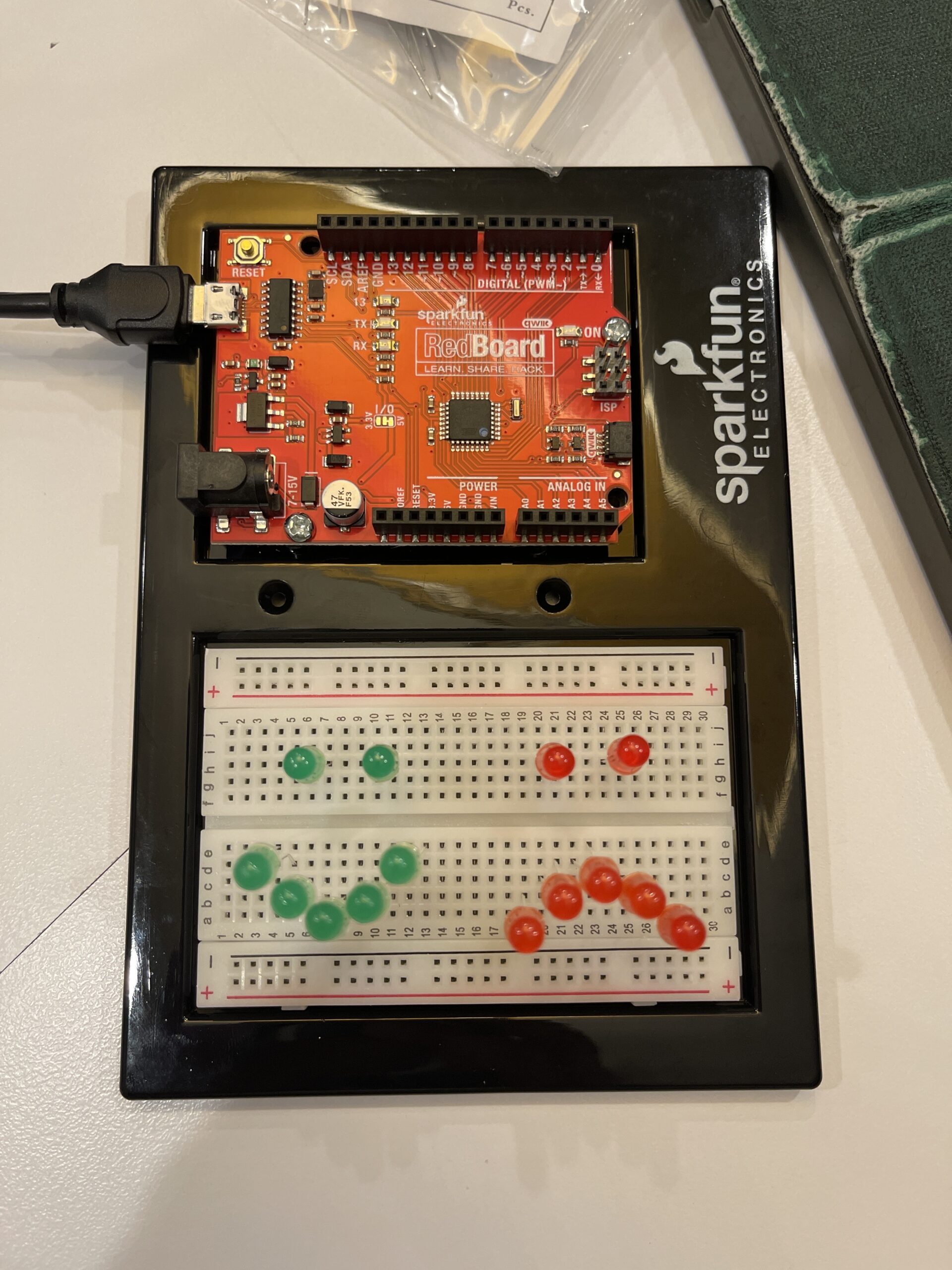
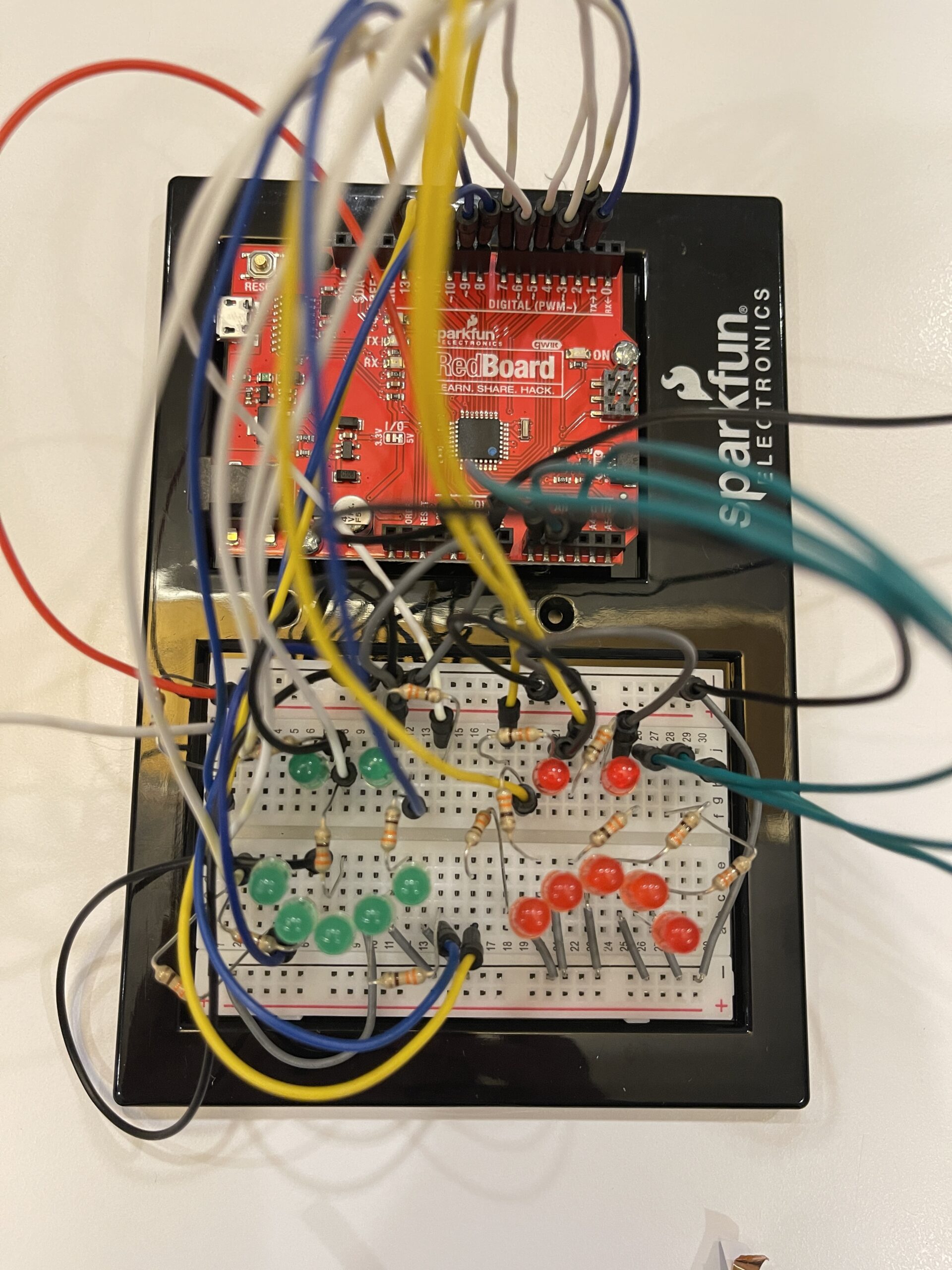
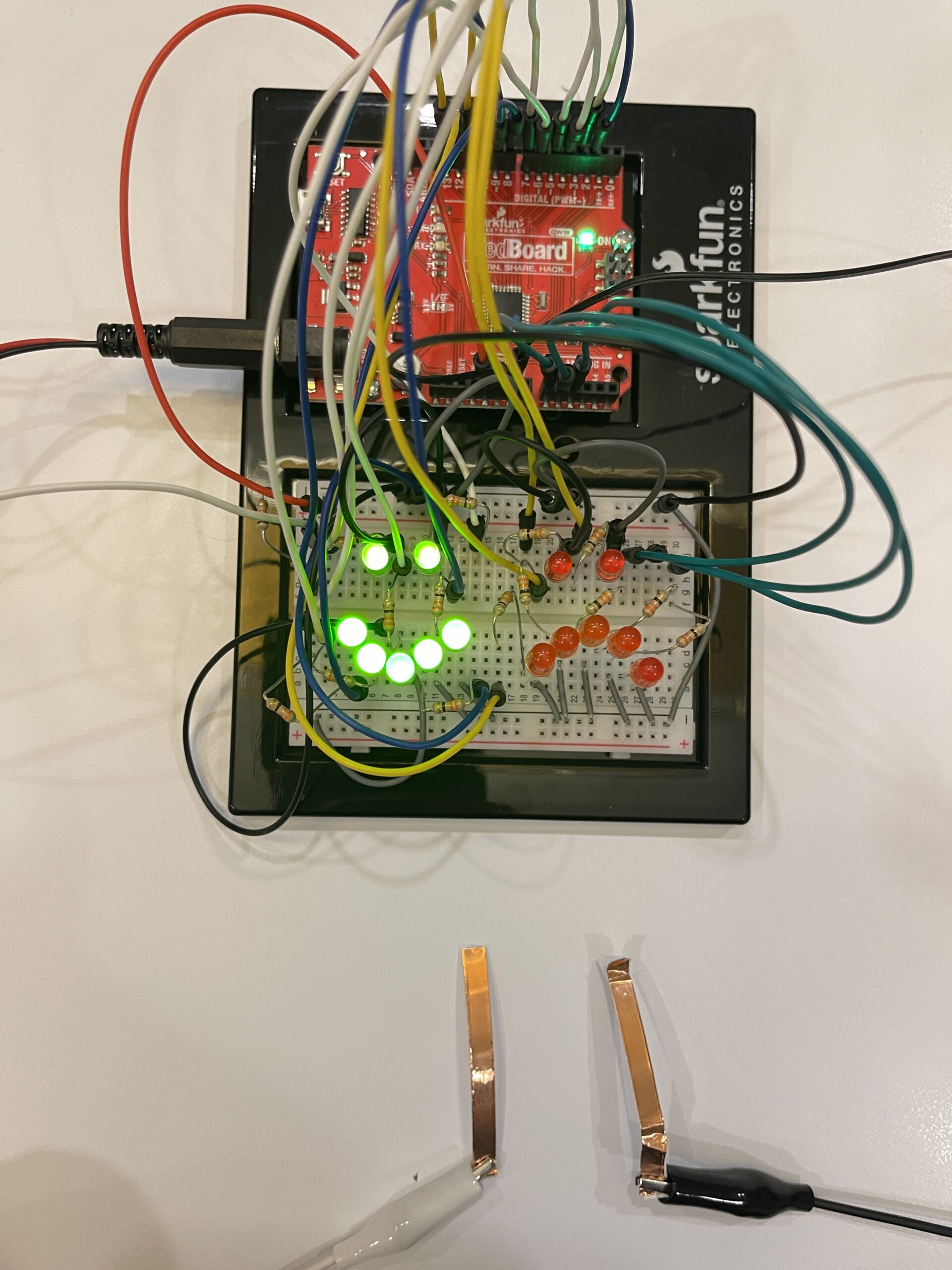
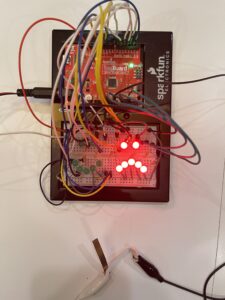
This project explores a hands-free switch using facial movement. Instead of using hands, I used eyebrow movement as an input. When I frown, the system detects it and turns on a sad red face. When I relax my face, it switches to a happy green face.
How it works:
The system uses a digital input to detect whether the switch is ON or OFF. This input is controlled by copper tapes to contact triggered by eyebrow movement.
If the input is HIGH, the green LEDs (happy face) turn on.
If the input is LOW, the red LEDs (sad face) turn on
Each LED is connected to a digital pin with a 330Ω resistor to limit current.
Red LEDs and green LEDs are connected to separate pins so they can be controlled independently.
⸻
Code that I proud of:
if(state == HIGH){
  // Normal face → Green LED lip
  for(int i=0;i<7;i++){
    digitalWrite(greenPins[i], HIGH);
    digitalWrite(redPins[i], LOW);
  }
} else {
  // Angry face → Red LED lip
  for(int i=0;i<7;i++){
    digitalWrite(greenPins[i], LOW);
    digitalWrite(redPins[i], HIGH);
  }
}
Problem encountered:
Initially, I tried connecting multiple LEDs to one pin, but I learned from Professor Aya’s lecture that Arduino pins have current limits. I solved this by using multiple pins and resistors.
Reflection:
This project helped me understand how digital input works and how the human body can be used as an interface. It also taught me polarity and about current limitations and proper LED connections. I found it interesting that something as simple as facial movement can be turned into an interactive system.
Connecting to the other article, for this article I found a fascinating contrast between emotional design and highly technical engineering. Hamilton’s work on Apollo software emphasised much more on reliability, error prevention, and anticipating human mistakes, especially in stressful situations where users (astronauts) could not afford confusion. This aligns with the idea from the design reading that in high-pressure contexts, systems should prioritize clarity and function over aesthetics. However, both readings highlight the importance of understanding overall human behaviour whether it is just emotions affecting usability or human error affecting software systems. Personally, this connection made me rethink of design as not just visual or technical, but deeply resonating with human creativity and thinking. It also made me appreciate how Hamilton’s foresight in error-handling actually reflects a kind of “design thinking,” even in engineering. Together, the readings suggest that good design whether it’s interfaces or software comes from anticipating and seeing how humans actually act, think, feel, and make mistakes.
Another aspect of the Hamilton reading that I found particularly meaningful was how her work challenged both the technical and social assumptions about software and who could create it. At the time, software wasn’t even considered a central or prestigious part of engineering, and yet Hamilton insisted on its importance, eventually creating the term “software engineering.” This made me reflect on how new fields or ideas are often undervalued until their impact becomes undeniable. I also found it significant that she anticipated human error such as the famous Apollo incident where the system prioritised critical tasks during overload which directly connects to the idea of designing for real human behaviour rather than ideal users. This raises a broader question for me which is how many current technologies today are still being designed under unrealistic assumptions about users? Overall, this reading reinforced my understanding that innovation isn’t just about technical skill, but also about challenging norms and recognising problems that others overlook.
In the reading on design and emotion, The idea that “attractive things work better”, caught my attention not because they’re objectively more functional, but because they change how we think and feel while using them. This challenged my assumption that usability is purely logical and efficiency-based. I realized that whenever I feel relaxed or positive, I would actually be more creative and tolerant of small problems, which aligns with the author’s argument about positive affect enhancing breadth-first thinking. This made me reflect on my own experiences with technology and even on my own projects as sometimes I focus too much on making things technically correct and being a perfectionist rather than enjoyable. It also raises a question for me was that if aesthetics can make users overlook flaws, is there any risk that designers might rely too much on appearance instead of improving actual functionality? I think the reading suggests a balance, but it leaves open how far that balance should go in real-world design.
Another idea from this reading that stood out to me was the contrast between positive and negative affect in shaping how we process information. The author explains that negative emotions can actually improve focus and depth of thinking, especially in stressful situations. This made me reconsider my assumption that feeling “good” is always better for performance. In fact, I can relate this to moments when I am under pressure such as before exams or deadlines where I become more focused and detail-oriented. However, this also raises a question that how can designers intentionally design for both emotional states? It seems difficult to create a system that supports both creative exploration and precise decision-making at the same time. This tension made me realise that design is highly dependent on context, and that there is no single “best” design and that only the designs that are appropriate for specific emotional and situational conditions.
This reading challenges the common stereotype that computer vision has to function similarly to human vision by highlighting how opaque digital images are, meaning that computers cannot interpret them without algorithms. It shows that computers basically cannot function if there were no algorithms to program them. Unlike humans that can constantly interpret context, different types of objects and different meanings, computers rely on simplified techniques, algorithms and systems such as frame differencing, background subtraction and brightness thresholding to detect movement or presence. For example, the reading explains that frame differencing compares pixel changes between frames, while background subtraction depends on differences from a stored image of the scene. This actually made me realise that computer vision is actually much more dependent on certain conditions having to work than I really initially thought. For instance, background subtraction only works if lighting and contrast are carefully designed. This shows that seeing for computers is more about structured assumptions. Meanwhile, the reading shows that we can actually guide what computers see by designing the background and physical environment, such as using high contrast, stable lighting or even infrared to improve detection. This connects to the idea of interactive media, where it’s not just coding systems but also designing physical and visual conditions that shape interaction.
What I felt was most interesting was how computer vision’s ability to track people overlaps with surveillance, and how artists actually engage with this. The reading discusses works such as Sorting Daemon and Suicide Box, where tracking systems are used to monitor and analyze people, sometimes raising ethical concerns about profiling and data collection. This made me question whether interactive art using computer vision is actually empowering participants or not. On one hand, projects like Videoplace create an embodied interaction where the human body becomes part of the system, but on the other hand, surveillance-based works turn viewers into objects of analysis. I think this is what makes computer vision powerful in art as it can both engage and critique. However, the author seems somewhat biased toward presenting computer vision as accessible and empowering for artists, while not fully addressing issues such as privacy and ethical risks. This raises a question: as computer vision becomes easier to use, how should artists balance creativity with responsibility? I also wonder whether using computer vision in interactive art always requires some level of surveillance, or if there are ways to design systems that avoid this dynamic altogether.
My midterm project, The Polyglot Galaxy, is an interactive generative text artwork that visualizes multilingual greetings as floating stars in a galaxy environment. The project expands on my Week 6 text generator into a more immersive interactive media system that implements text, sound, animation, state-based interaction and computer vision.
As each time the user clicks on the canvas, a greeting phrase from a different language is stamped onto the screen. Over time, these phrases accumulate and form an interstellar constellation like galaxy. Within the frame, it will display 4 different voices for my project I changed from a 400, 400 to a 600, 600 frames in order for the game to look a bit larger and I decided to split the frame into 4 quadrants consists of upper left, upper right, lower left and lower right. The visual aesthetic is inspired by space, glow, and floating motion, which represents languages as stars in a shared universe.
The visual aesthetic focuses on glow, floating motion, and cosmic space imagery. The project also includes a webcam frame that reacts to movement and brightness in the camera view. When the user moves or dances inside the camera frame, the brightness changes and the stars twinkle more strongly, making the interaction more interactive and playful. Sound is also integrated to create an immersive environment where clicking produces different audio effects and ambient music will be played during the interaction.
Progress Made:
During this spring break, I made improvements to both the visual interaction and the system structure. Firstly, I implemented a blinking glow effect using sin(frameCount) to animate and increase the brightness of the instruction text and the star-like greetings. This creates a subtle pulsating effect that help reinforces the galaxy atmosphere in the frame.
Secondly, I added 8 bursts that have tiny sparkles in the galaxy which was an idea implemented from Dan Shiffman video on the coding train and when the user clicks on the canvas. These small particles would spread outward like tiny dwarfs or planets and a bit like dancing stars. This gives the interaction a more dynamic, lively and playful feel.
Furthermore, I introduced some state-based interaction using a start screen and play state. When the project first loads, a start screen appears with instructions. After clicking, the user enters the interactive galaxy mode where phrases can be stamped.
Another major improvement is how I integrated more of the webcam computer vision. Where I had the camera showing the player of the game. The camera brightness is found by sampling pixels from the webcam feed. This brightness value then controls the speed and intensity of the interaction, meaning the stars react to movement or lighting changes in the camera frame.
Lastly, I also improved the layout and interface to make it more readable by adjusting the position of the instruction text and ensuring it fits nicely within the frame. Moreover, I felt that the background music plays continuously during the play state to create an atmospheric soundscape as I decided to have music that resembled galaxy in space.
Code
Below is the code I am particularly proud of, and the core logic used to capture webcam data and calculate brightness for interaction:
cam = createCapture(VIDEO); // use computer cam
  cam.size(160, 120);
  cam.hide();
}

function updateCamBrightness() {
  cam.loadPixels();
  let sum = 0;
  // sample pixels +40 for faster
  for (let i = 0; i < cam.pixels.length; i += 40)
// +40(RGBAx10) for faster and get realtime
{
    let r = cam.pixels[i];
    let g = cam.pixels[i + 1];
    let b = cam.pixels[i + 2];
    sum += (r + g + b) / 3;
  } // bright->r,g,b will high and sum will high

  let samples = cam.pixels.length / 40;
  camBrightness = sum / samples; // Avg brightness = 0..255
}
Sampling every 40 pixels helps reduce computational load while maintaining responsive interaction. This allows the program to run smoothly even while performing real-time visual updates.
I am also proud of the 8 sparkle burst effects, which adds immediate visual feedback when users interact. Despite its simple implementation as a lightweight particle system, it significantly improves the sense of energy and responsiveness in artwork while maintaining a good performance.
Challenges I encountered involved browser permissions and webcam access. In some environments, the camera simply doesn’t activate unless the page is running in a secure context or the user explicitly allows permission. To avoid interface issues, I chose to hide the raw camera feed and use it primarily as a data source for interaction.
Another challenge was to balance visual complexity with performance. Since the project involves having multiple animated objects and real-time pixel analysis, I needed to optimize certain processes, such as sampling pixels at intervals instead of trying to process the entire image frame.
In the future, the user interface could be improved further with clearer interaction prompts and more refined visual transitions.
Things to Improve for the Future
Although the project works well still there are several areas I would like to improve in the future.
Firstly, I would like to expand the number of languages and phrases in the dataset as currently the phrases come from a JSON file, but increasing the diversity of languages could make the galaxy feel richer and more global.
Moreover, I want to improve the visual design of the stars and glow effects such as by adding stronger particle systems, gradients, or shader effects could make the galaxy feel deeper and more immersive.
In addition, I would like to refine the interaction between the webcam and the visuals. Because as of now the brightness only affects twinkle speed, but in the future it could also influence star size, color, or particle behavior.
Last but not least, the sound design could be expanded because of now clicking produces different sound effects depending on the screen quadrant, but I would like to develop a more reactive sound system where the music evolves as more languages appear in the galaxy.
Overall, I felt like this project really helped me to explore how generative text, animation, sound, and computer vision can combine into a playful interactive media experience.
References
• Daniel Shiffman. (2019). The Coding Train: p5.js Tutorials.
https://thecodingtrain.com/
These tutorials helped me understand concepts such as webcam capture using createCapture(), particle systems, and generative animation techniques used in this project.
• p5.js. (n.d.). p5.js Reference.
https://p5js.org/reference/
The p5.js documentation was used as a reference for functions such as loadJSON(), sin(), map(), createCapture(), and frameCount that are used throughout the project.
• Casey Reas and Ben Fry. (2014). Processing: A Programming Handbook for Visual Designers and Artists. MIT Press.
• Coding Challenge 78: Simple Particle System
My midterm project, The Polyglot Galaxy, is an interactive generative text artwork that visualizes multilingual greetings as floating stars in a galaxy environment. The project expands onmy Week 5 text generator into a more immersive interactive media system that integrates text, sound, animation, state-based interaction, and computer vision.
As each time the user clicks on the canvas, a greeting phrase from a different language is stamped onto the screen. Over time, these phrases accumulate and form a constellation-like galaxy. Within the frame, it will display 4 different voices. The visual aesthetic is inspired by space, glow, and floating motion, which represents languages as stars in a shared universe.
For Week 6, I introduced webcam interaction as a form of real-time input. Instead of functioning only as a background element, the camera actively influences the visual behavior of the system. The brightness detected from the live webcam feed controls the twinkling speed and intensity of the text objects. This transforms the artwork from a static generative system into an embodied interactive experience where the audience’s movement directly affects the visuals.
function updateCamBrightness() {
  cam.loadPixels();
  let sum = 0;
  for (let i = 0; i < cam.pixels.length; i += 40) {
    let r = cam.pixels[i];
    let g = cam.pixels[i + 1];
    let b = cam.pixels[i + 2];
    sum += (r + g + b) / 3;
  }
  camBrightness = sum / (cam.pixels.length / 40);
}
I am particularly proud of successfully integrating computer vision into a generative art system in a simple yet meaningful way. Rather than just implementing complex face detection (which would be rather computationally heavy and technically advanced), I chose brightness-based interaction. This decision balances technical feasibility, performance efficiency, and conceptual clarity.
Moreover, I am also proud of the object-oriented structure of my code. The GreetingText class encapsulates the floating animation, glow effects, blinking, and camera-reactive twinkling within a reusable system. This makes the project scalable and organized as more text objects are generated over time.
One major challenge I encountered was browser permission and issues related to the webcam. In some environments, the camera feed just doesn’t function unless the sketch runs in a secure (HTTPS) context or after the user grants camera permission. I addressed this by using the webcam primarily as a data input rather than relying on it as a visible visual component.
For improvements I would like to imagine as we know after the midterms we would be focusing on more hardware related stuff and therefore I would like to incorporate the functions of a camera where if you swipe left it would display a phrase in a language and if you swipe right it would display another language in another phrase and if you swipe up does another phrase in another language.
References
-Course Lecture Slides: Week 6 – Computer Vision & DOM (Introduction to Interactive Media)
-Daniel Shiffman, p5.js Video and Pixels Tutorials
-p5.js Documentation: createCapture(VIDEO) and pixel processing
-Creative Coding approaches to camera-based interaction in interactive media
For my midterm project, I decided to develop an interactive generative artwork called Polyglot Galaxy. The concept is to create a multilingual visual space where users can click to “stamp” greetings from different languages onto a galaxy background. Each click generates a unique phrase using randomness, along with visual glow effects and sound feedback. My goal is to combine text, image, sound, and object-oriented programming into one interactive experience that reflects my interest in languages combining aesthetics like sounds, animations.
In terms of user interaction design, the program starts with a start screen and transitions into the play state after the first click. Once the user enters the play mode, clicking on the canvas generates a new greeting text at the mouse position. The phrases are randomly selected from a JSON file and styled with different sizes, colors, and blinking alpha effects using sine functions.
The coded that I am proud of would be:
// sound on click
 if (mouseX <= 300) {
   clickSound.play();
 } else {
   clickSound1.play();
}
As I also implemented two different sounds depending on the click position (left or right side), where split in the middle if you click towards the left side of the frame it will play 0.mp3 file sound more of a peep sound and if you click more towards the right side it would play 1.mp3 sound more deep and it also restart function using the “R” key to reset the session without reloading the page. This structure I think gives a good step by step approach.
From a coding perspective, I have begun designing the project using functions, classes, and interactivity as required. I created a GreetingText class to manage each stamped phrase as an object, including its position, color, size, glow shape, and blinking animation. The generatePhrase() function handles generative text creation using randomness from language data, punctuation, and decorative elements. Moreover, I added a state system (“start” and “play”) to control the interface flow.
The challenging part was integrating multiple media elements together incorporating sound playback, generative text from JSON, and object-oriented animation in the same system. To reduce this risk, I tested each component separately by doing sound playbacks on mouse click, image backgrounds for different states, and a prototype class for animated text objects. I also added a limit to the number of stamped texts to ensure the sketch runs smoothly.
I think maybe I can improve by adding some songs into the galaxy output at the start menu to attract people e.g. assuming you were watching the movie guardians of the galaxy or universal starting music.
The reading made me think back on how invisible software work used to be in the past and how easily important contributions can be overlooked nowadays, especially when they do not fit dominant expectations of who a “technical innovator” should actually be. The article highlights that software wasn’t even considered important in the early Apollo mission planning, which aligns with how many modern technological systems still undervalue behind-the-scenes digital labor. From my own experience studying technology and creative coding, I see a similar pattern which is that people often praise visible outputs (design, hardware, final product) while ignoring the programming logic that makes everything function. This actually supports the author’s point that Hamilton’s work was revolutionary not only technically but conceptually, because she helped establish software as a legitimate engineering discipline. But at the same time, the reading also challenges my previous assumption that space exploration was mainly about hardware and astronauts; it made me reconsider how much critical decision-making and problem-solving actually happens in code and systems design.
However, the author might show some bias by strongly linking Hamilton as a singular heroic figure, which risks simplifying the collaborative nature of large-scale scientific projects. While the article acknowledges teams and engineers, it still centers a narrative of individual genius, which is common in technical journalism and can actually overlook collective labor and institutional structures. This raises questions for me about how history chooses which contributors to actually highlight and which to marginalize. I also wonder whether the article’s emphasis on gender barriers, while being important, might shape the story to fit a modern narrative about women in tech rather than fully exploring the technical debates and engineering processes of the time. The reading ultimately makes me question how innovation is actually thought off. Do we celebrate people based on their actual impact, or based on how well their story fits contemporary social values and narratives about progress and inclusion?
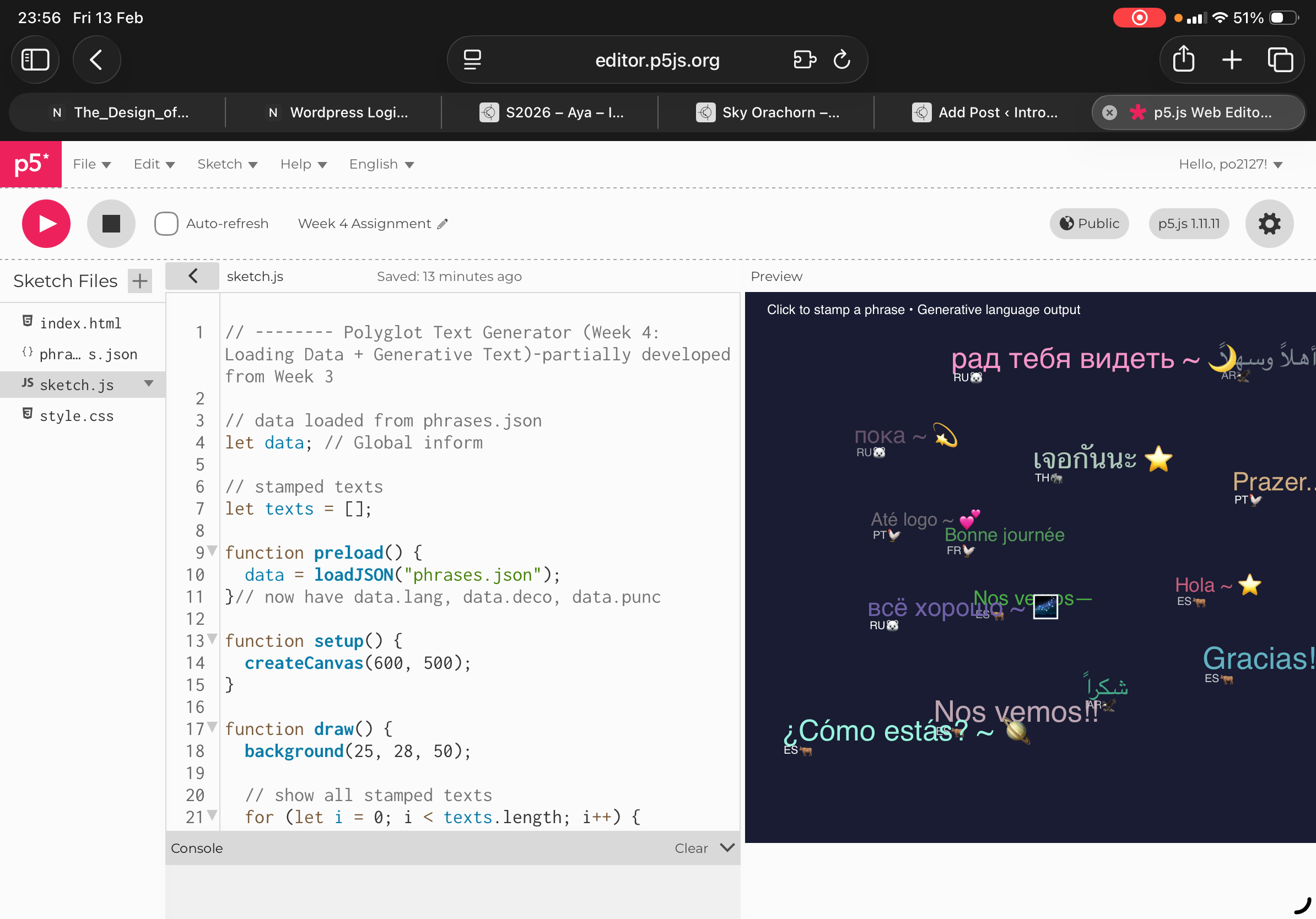
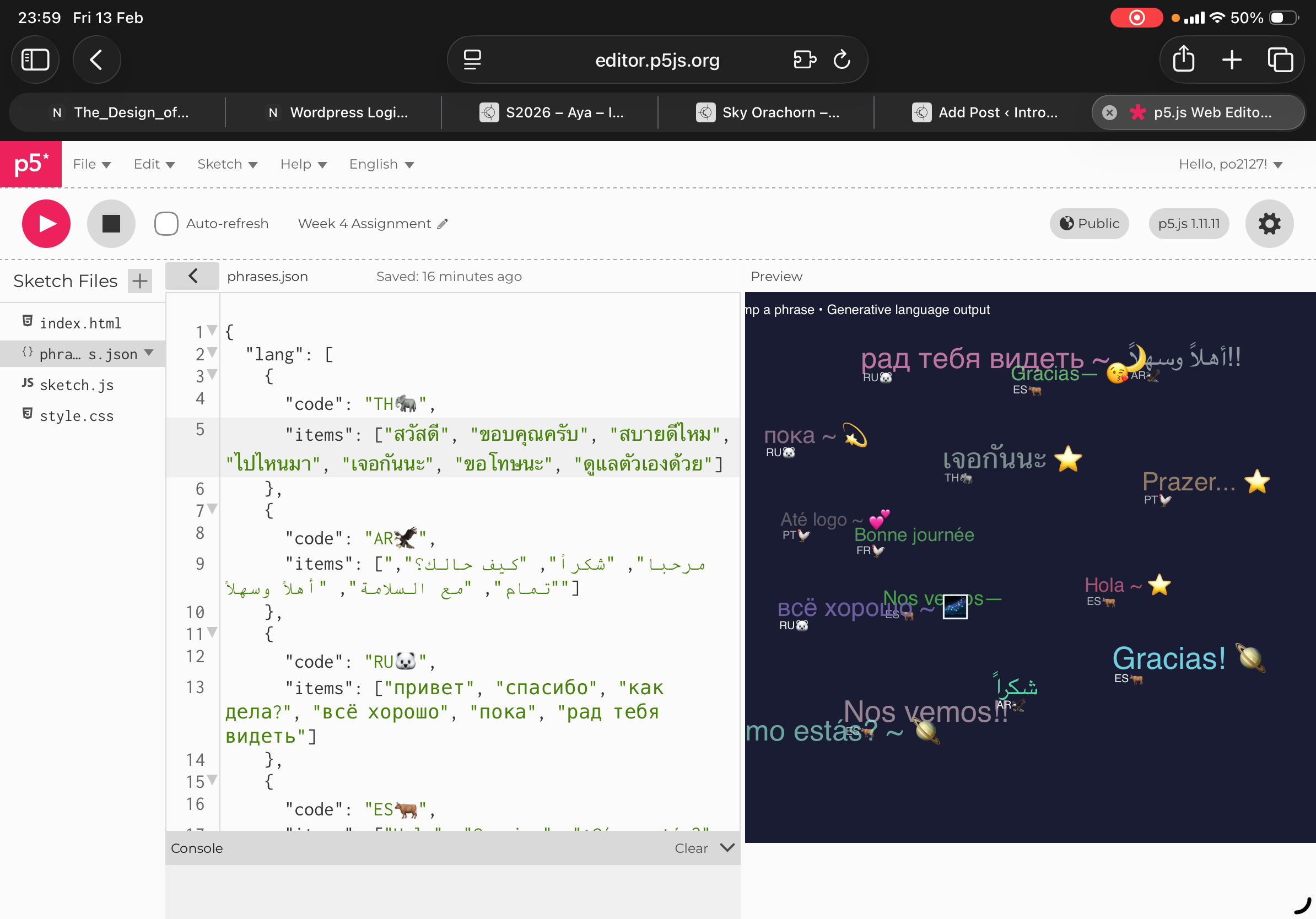
For the concept of my work, I based on what I partially developed from week 3 where last time I did a bubble generative text from the mouth drag, and how after dragging the mouse after the output would make lots of bubbles react, thus this time I did greetings and simple phrases from each of the languages that I speak. From watching the video tutorial 1.4 on JSON Data I was able to break it into 3 sections language, punctuation, decoration where for each greeting or word language I set a random variable deco where output randomly decides to go along with language, punctuation and decoration respectively. Once again ranking all of the arrays within the square brackets.
The key codes that I am proud of were the code stamped texts: Where I let text = array and where I set the function to put the line 56 (main text) and line 61 the emoji run it into the array. Secondly, for the IF text length I inputted the function where if text length is more than 20 this means that in the 21st click after running output my result. Would come out as. The first phrase that showed in the first click after running the output would disappear . Also lastly I inputted a sin(frameCount) function as currently my code after running output has some blinking going on so I ran it into a way that it would appear as wave that run smoothly.
In terms of what I think I could improve in the future would be to play around with functions that everytime that a text have “burst up” and burst everytime that we click. So overall is to explore more with varieties and different animations , etc.
I&M Reading
Reading this chapter made me really think how I would interact with everyday objects in a very personal way. As I used to assume that if I struggled with something simple such as a confusing door, a complicated appliance, or a strange interface I now think it was my own fault. The reading argues that these frustrations usually come from poor design, not user incompetence, which felt astonishing and an eye opener. The examples about doors and household devices made the ideas feel very realistic, because they reflect small annoyances we experience almost daily without questioning them. It made me realize how much of my behavior is lead by intuitive signals from objects, and how frustrating it becomes when those signals are kind of unclear or misleading. What drives me crazy is when everyday interfaces have too many unclear buttons, hidden functions, which could be improved by using clearer signifiers, simpler layouts, and immediate feedback so users do not have to guess what to do.
What I found especially meaningful is the emphasis on human-centered design and the idea that designers should adapt to human psychology, not expect humans to adapt to machines. This perspective feels very relevant in today’s technology-heavy world, where many products are powerful but not intuitive. The discussion about discoverability, signifiers, and feedback made me more aware that good design should communicate naturally without needing long instructions. Overall, I think the reading is insightful because it shifts the way we see mistakes as instead of blaming users for the confusion, it encourages us to critically evaluate the design itself, which feels like a more human and realistic approach to technology and everyday life.