Week 2 Assignments

My concept of creating loops within this ring was to use the for and let commands to signal whether if the value satisfies this statement go for this number, or if the number doesńt satisfy the first condition set it might satisfy another condition. For the animation part I was thinking of first off setting G as a variable equal to the radius of circle + sin which is to move and go around in and out.


In terms of the code I am particularly proud of the lines for (let r = 10; r <= 280; r +=10) as I felt like I gave my code a specific radius to the width of the generative rings. Also, I like the code text(“&Generative Rings”) just because it was a little gimmick and emoji that I wanna create as an aesthetic to my project. Also I am proud of the code: let g = r+sin(frameCount * 0.05) * 10; because when having sin within the formula this allows the output to blink in and out like a wave and the frame count I set it to be *10 blinking in order to blink in and out faster but not too fast.

for (let r = 10; r <= 280; r += 10) {
let g = r+sin(frameCount * 0.05) * 10;
ellipse(200, 200, g, g);

Screenshot

<iframe src=”https://editor.p5js.org/po2127/full/cqCZ4-6WU”></iframe>

https://editor.p5js.org/po2127/full/cqCZ4-6WU

Cites reference:

https://p5js.org/reference/p5/sin/

https://p5js.org/reference/p5/for/

In terms of reflection on this work I was proud that as I once did a little bit of loops before when I was in high school for only 1 class and made me recall how the accumulated knowledge from that time really helped me get a better grasp at loops now for this project and I am able to apply this concept in more creative ways like this, and I also appreciated how to make animations using coding for the very first time, ideas for improvement would be to experiment with different types of loops not just for but incorporating others such as if else statements and that we have other formulas to make animations using coding.

Week 1: Self-Portrait (catch up)

My concept:
For the first assignment of this course, I began by thinking about how I would like to create my self-portrait. I was inspired by looking at different examples from other students and animations of different things. As I reflected on who I am and what I like, I immediately thought of the Blooket character I always chose, and I decided that it would be a perfect way to represent myself. I attempted to create a wolf animation inspired by the Blooket version using 2D shapes and colors, and I wanted to add a creative touch by including sunglasses, as I felt they fit the image and personality I’m trying to display. Below is the reference image for the Blooket animation:

Embedded Sketch:

My vision was for the wolf to have sunglasses that go on and off. As a beginner in coding, I was able to create this effect by programming the glasses to move up and back down using the simple (mouseY) on the wolf’s face. This represents how I wanted the animation to be shown:


A Code I’m proud of:
A part of the code I am particularly proud of in this assignment is the eyes, along with the glasses. While creating the eyes, it took me a long time to adjust the edges and curves of the eye, then find the perfect size for the pupil, followed by adjusting the placement of the small white circles that makes the eye look more realistic. I tried with many different shapes to find what fit best, including circles, ellipses, and rectangles, in a variety of sizes.

//Eyes - In three parts:
//The wider white part of the eyes
fill("white");
rect(155, 190, 50, 50, 15, 10, 40, 20);
rect(240, 190, 50, 50, 15, 10, 40, 20);

//The pupils as black ovals 
fill(0);
ellipse(233, 195, 28, 40);
ellipse(148, 195, 28, 40);

//The small white circles to add a better look
fill("white");
circle(150, 207, 13);
circle(235, 207, 13);
//Glasses with movement
  fill(0);
  rect(155, mouseY, 60, 50, 10, 10, 50, 50);
  rect(240, mouseY, 60, 50, 10, 10, 50, 50);
  rect(197, mouseY, 30, 10, 5, 5, 5, 5);


Reflection and ideas for future work or improvements:
Overall, I am satisfied with the outcome of this assignment, especially since it was my first coding project and I completed it independently. I was able to use different references from the official p5.js website, along with the slides provided in class, to apply what I learned and create this self-portrait. For future work, I would like to improve the complexity of shapes and add more detail to the image. Additionally, I hope to further develop my coding skills so I can program the sunglasses to move more realistically, sliding up onto the wolf’s head and back down over the eyes, similar to how sunglasses work in real life.

References:
In this sketch, I used the class weekly slides covered provided by the professor, along with the p5 website, specifically the “Reference” page to explore different things I can add and control.
https://p5js.org/reference/ 

Reading Reflection – Week2

I hope to incorporate randomness as a touch of freedom to the well ordered code if I am intending to make a work of art, but use it as a functional tool if the work is to be of practical use. I wouldn’t want to use too much randomness, and I don’t want to make randomness the center of focus. The video mentioned randomness and chance and demonstrated it as a novel and  individual element in art, which deviates from my understanding of what art is. The speaker seems to be defining randomness using its most limited definition: true randomness generated without bias, unlike what the human brain would give, and claimed that artistis used to be responsible for order.  I personaly would like to believe that randomness is not so strictly defined, and that artists, especially the abstractionist, are probably the most random people among the population apart from psychopaths. They are the human end of randomess, and what they exhibit is a randomness enriched with meaning, emotion and expression.

This is why the way the speaker uses randomness as an artist is not something I would agree with. I believe art should be something more than the shapes and forms of the surface. The beauty ought to lie in the emotions and expression depicted through the work. There is a soul behind the cavas, whether physical or electronic. The extend to which the speaker pursures randomness is excessive. It is more a research of randomness rather than art. The lines and shapes created contain no meaning, and is a mere experiment that is goodlooking. There is no soul behind this. I don’t see this differently as a graph that may be formed from the data of a failed scientific experiment. The scale of randomness in art I would prefer is when the artist tries to express something through the randomness. For example: A work of random lines and connections that resulted from controlled code and processing afterwards that is aimed at expressing the pressure of modernlife and slight moments of relaxation people find within (I have this in my mind as a graph of crowded random lines where the gaps are bigger in some places). This would be my ideal of the scale of randomness: controlled and not covering over the emotions or the “soul”.

Week 2 – Reflection

When I watched Casey Reas’ Eyeo talk on Chance operations, I started thinking differently about how i use control in my art. Reas explains that the computer is not just a tool that follows orders, but a creative system that can use chance in a planned way. One part that really stood out to me was when he talked about artists like Sol LeWitt, where the instructions are the artwork and the final image is just one version of many possibilities. That made me realize that art does not always need to be fully planned to be meaningful. I noticed that in my own work I usually avoid randomness, especially when I paint portraits. I like to control the faces, expressions, and details, and I feel like adding random elements could ruin the image I worked hard on. I like knowing what the final result will look like and follow the structured plan of how it’s suppose to turn out. But Reas helped me see that even when a system creates something unexpected, it still comes from the artist’s ideas and decisions. Making me realize even when mistakes are made, sometimes it still helps us see that it can turn the thing we are creating better (whether it’s planned or not).

Before watching the talk, I thought randomness mostly made things messy and out of control. Now I understand that randomness can be planned and guided by rules. Reas explains how simple systems can create complex behaviors, and that really changed how I think about art. If I use chance in my own projects, I want to start with movement. Movement creates emotion and makes the artwork feel alive, and letting it behave in a slightly unpredictable way can make it more interesting. I also think randomness can make my projects more unique instead of looking repetitive. At the same time, I believe there needs to be a balance between chaos and structure. If a project is formal or important, too much randomness can feel a bit overwhelming, confusing or disrespectful. For me, the best balance is when I control the main rules but let chance decide small details, like position or scale. After watching Reas’ talk, I see chance not as something that ruins my work, but as something that helps me explore new ideas and think differently when working with projects, art, assignments, writing and etc.

Week 2 – Loop Art

My Concept

For this assignment, I wanted to create something simple, structured, and fully based on the techniques from the Week 2 slides. I decided to build a grid of squares using nested loops, just like the examples shown in class. But instead of keeping the grid static, I wanted it to feel a little more interactive.

My idea was to make the colors shift whenever the mouse is pressed, using the built‑in boolean variable mouseIsPressed from the slides. The end result of my project is a grid of evenly spaced squares that change color in a smooth loop every time you click.

Snippet of the code I’m proud of:

if (mouseIsPressed) {
  colorShift += 2;
}

if (colorShift > 255) {
  colorShift = 0;
}

I’m proud of this part because it uses boolean logic and variable incrementation.

  • When the mouse is pressed the variable colorShift increases.
  • This creates a looping color effect and it shows how conditionals and variables can work together to create interaction.

Embedded sketch:

How I made this: 

I started by creating a canvas using createCanvas(600, 400), just like in the examples from class. Then I used nested for loops to place squares across the screen.

To make the squares spaced further apart, I increased the loop step to x += 70 and y += 70. This gives the grid a clean, airy look.

Next, I added a variable called colorShift that starts at 0. Using the boolean variable mouseIsPressed (from the slides), I made the number increase whenever the mouse is clicked. This number is then added into the fill() colors so the squares change color interactively.

I also used simple conditionals (if, else if, else) to change the color depending on how far down the screen the square is.

Finally, I drew each square using rect(x, y, 50, 50) inside the nested loops. Because the loops repeat across the whole canvas, the pattern fills the screen automatically.

Reflection and future ideas

Overall, I’m really happy with how this piece turned out, because it uses simple tools like loops, conditionals, boolean variables, and a bit of animation, yet it still manages to feel interactive. Even though the sketch is built from very basic building blocks, the way everything works together makes the grid feel responsive and alive.

Using mouseIsPressed was especially fun, because it showed me how a single boolean variable can instantly make a sketch interactive. Just clicking the mouse changes the colors across the whole grid, and that small action makes the code fun.

If I had more time or knew more about p5.js, I would like to try more effects. For example, I could make the shapes respond to sound, or create more interactive features like clicking to make new shapes appear. I would also like to experiment with colors to make smoother gradients and more interesting palettes. In the future, I want to keep exploring user interaction and generative art using what I have learned so far and what I will learn next.

References

  • Week 2 Slides, (Conditionals, Loops, Boolean Variables) Used for understanding nested loops, mouseIsPressed, relational operators, and conditional logic.
  • p5.js Reference https://p5js.org/reference/ Used to check syntax for rect(), fill(), and basic drawing functions.

Week 2 – Loop Art

My Concept:

I started by looking at the links to computer graphics magazines. provided. A recurring theme I noticed is the repeated use of squares, circles, and other geometric shapes. So I knew that I wanted my design to incorporate a heavy geometric theme. As a beginner P5 coder, I wanted to make sure I could execute this idea with what I had learned so far. I ended up creating a square-oriented piece that offers the user interactions to play with, inspired by old computer art magazines. The piece features a canvas covered with animated squares across the grid that change color depending on the mouse’s position (left or right). On top of the dynamic background is a moving square that changes direction with a mouse click, creating a final artwork that evolves through loops. 

Highlight of Sketch:

// i is the variable used for the outer loop and controls the x positions across the canvas.
// j is the variable used for the inner loop and controls the y positions down the canvas. 
for (let i = 0; i <= width; i += 25) {
  for (let j = 0; j <= height; j += 25) {
    
    // r and g represent red and green values, and this line of code generates random color values adding some variation to the work.
    // mouseX controls the blue values and allows the user to move the mouse to change the color of the grid.
    let r = random(200,255);
    let g = random(100,200);
    let b = mouseX;
    
    //stroke created by using the red, green, and blue values initiated above. 120 represents the transparency of the circles.
    // ellipse uses the variables i and j to generate squares at each point of the grid.
    stroke (r, g, b, 120);
    noFill();
    rect(i, j, 20, 20);
  }
}

A particular part of the sketch I am proud of is the use of loops in my code. It was something new we had learned this week, and my incorporation of the inner and outer loop resulted in an outcome I am quite satisfied with and proud of. I am also proud of the randomized color variables in my code and of using mouseX to add user interaction with the colors.

Embedded Sketch:

How this was Made:

I started the process by setting my mind on what I wanted my piece to look like. After setting my mind on a specific idea, I then had to plan out how to execute it. I started my code by initializing my global variables, x and y, to store the current position of the moving square. Then I set speedX and speedY to control the direction and speed of the square’s movement. Then I set a lower frame rate with the frameRate() function to make the animation look cleaner and smoother. Then I used nested loops. An inner and outer loop that controls the grid background. The outer loop moves horizontally across (rows) the canvas, and the inner loops move vertically (columns) across the canvas. I set the red, green, and blue values and created random variables for them to add variety to the grid. The blue values are controlled by mouseX, so the user can change the grid color depending on whether the mouse is on the left or right side of the screen. Then I added the lines of code to create the main moving square. Then, using logical conditionals (or), I was able to have the square’s direction reverse once it hits any edge of the canvas. Finally, to add interaction to the code, I added the mousePressed() function, which allows the user to click the mouse to reverse the square’s direction. Using what I have learned so far, I created this fun final artwork.

Reflection and Future Ideas:

Overall, I am quite satisfied with my final piece and how I was able to combine what I have learned so far to create a fun, interactive piece with p5. Although the loop part and randomized variables part came with some trial and error, at the end I was able to overcome those obstacles and have an outcome I am proud of. For the future, I hope to learn more about p5 and create even more impressive pieces of work, specifically, more dynamic animations.

Assignment_2: loop art

Concept

I looked throught some of the old computerarts provided and some of the organized and innerric graphs reminded me of the golden curve and the related math arts that I have seen. I remembered that the seeds of the sunflower followed a certain mathematical pattern and decided to use that as the model for my computer art.

I did use AI in this assignment to understand the pattern and mathematical logic the sunflower seeds followed, and to figure out some basic formulas that would allow me to recreate such shapes, but the codes were my own.

Code chunk

for (let pointn = 0; c * sqrt(pointn) <= 150; pointn++) {
    let angle = pointn * 137.5;
    let x = c * sqrt(pointn) * cos(angle);
    let y = c * sqrt(pointn) * sin(angle);
    
    //The code can be played with using many math functions, I tried some and attached them below
    
    //without sqrt
    //let x = (c * (pointn)/10) * cos(angle);
    //let y = (c * (pointn)/10) * sin(angle);

    // logarith(also looks good when made 1*c)
    // let x =5*c * log(pointn) * cos(angle);
    // let y =5*c * log(pointn) * sin(angle);

    //1/log
    // let x =100*c * 1/log(pointn) * cos(angle);
    // let y =100*c * 1/log(pointn) * sin(angle);

    let r = map(x, -300, 300, 80, 255);
    let g = map(y, -300, 300, 80, 255);
    noStroke()
    fill(r, g, (r + g) / 1.65);
    circle(x, y, 3);

The full code is relatively short so I picked the for loop section because I think it shows exactly what loops are helpful for. This chunk of code greatly utalizes the efficency of loops. It would be extremely difficult and time consuming to draw all the dots with accurate spacing by repeated lines of code. The for loop allows drawing and editing of the dots in one line, making it much easier. I also thouht it is intereating that I am able to create different patterns using only change in the mathematical function and slight adjustment to numbers, so I included those modified codes as well.

I was able to recreate the sunflower pattern in resting first, but I thought it looked a bit dull. Because it was a round pattern and included curves, I decided to make it rotate around the center to have a bit of a dillusional effect. I looked up a video tutorial on youtube and learned how to move start point to the center of the canvas and how to rotate it. The effect is pretty good.

Reflection

Drawing a mathematical pattern probably does not really fit the requirement of doing computer art, but I believe the Fibonacci numbers and its related curves do all look quite artistic, and the massive amount of dots needed is an excellent medium for praticing loops. My finished work seems a bit easy and a bit short for an assignment, and I might decide to try something more complicated and in accordance with class difficulties in future assignments.

Another thing is that AI really is quite helpful in the case of understanding scientific or math related concepts. I wouldn’t have been able to figure out all the formulas myself. I will attach my conversation with Gemini in the reference section

References

  • https://www.youtube.com/watch?v=i5bs3SPpHdM
  • https://www.youtube.com/watch?v=z9d1mxgZ0ag
  • https://www.youtube.com/watch?v=3U8-9_WeuKE
  • https://www.youtube.com/watch?v=_GkxCIW46to
  • https://gemini.google.com/share/4c9531505d04

Assignment 2: Box Hit

Here is my final sketch:

Concept:

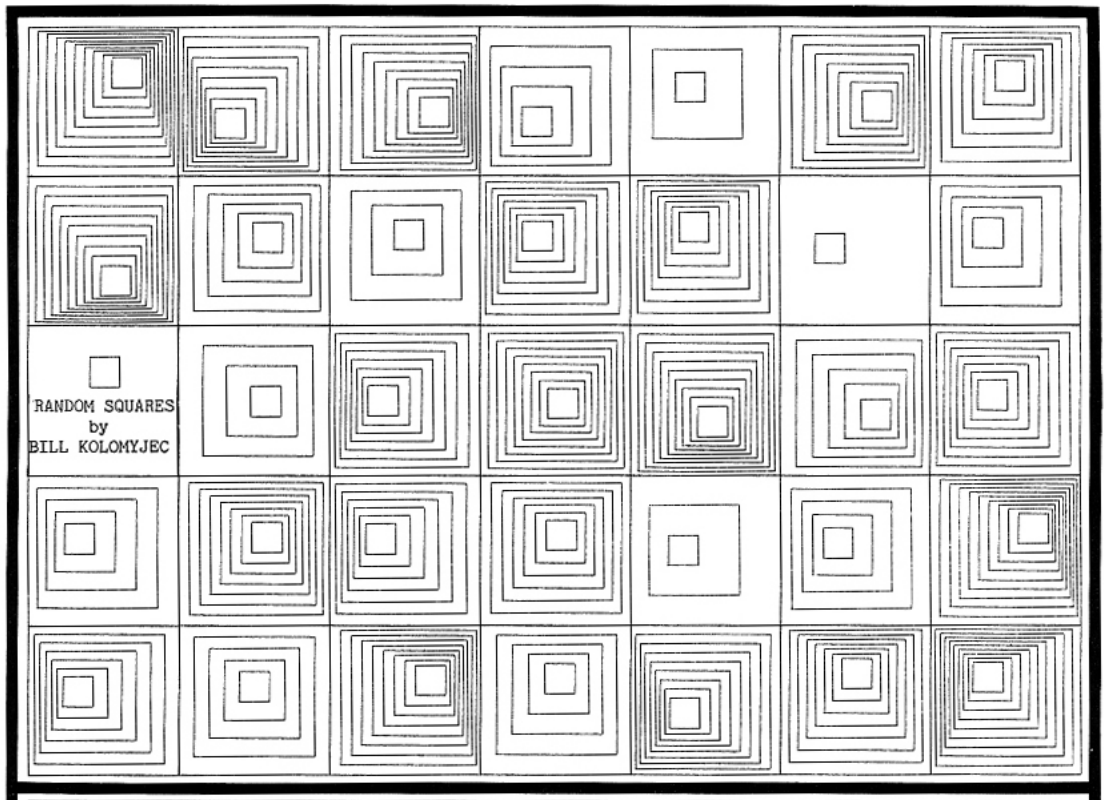
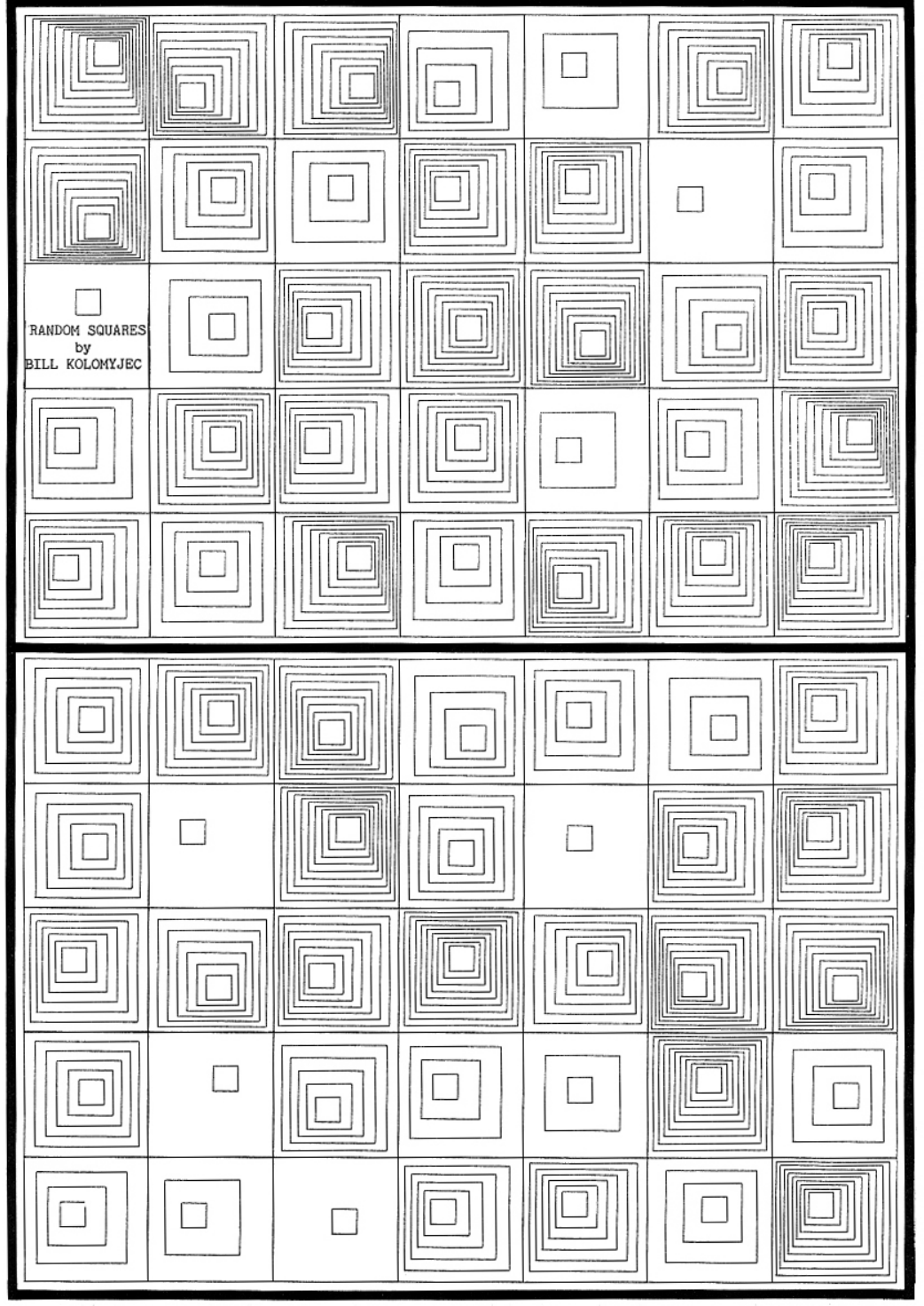
For this project, I was inspired by the game Smash Hit, where a ball hits glass and causes it to shatter. Also, while looking through the computer art magazines, I came across Boxes I by William Kolomyjec. I decided to combine these two ideas by creating a grid of squares with a circle in the center that acts as a button that triggers the distortion of the squares. 

The circle turns green when the viewer hovers over it and turns red when clicked. Once you click on it, the circle causes the squares surrounded by it to distort, kinda like in the artwork I was inspired by. I wanted a controlled system that slowly breaks apart, while having a game-like effect. 

Here is the artwork I was inspired by that was in the magazine:

Code Highlight:

The code that I am particularly proud of is the section that distorts the boxes based on their distance from the center and the randomness to its position and sides. It gave the visual effect I wanted. 

//distortion control using the radius
if (ruined && radius < 155) {
  //so if the disortion is on and the radius hasn't reached its maximum, expand the radius. I chose the number 155 because I didn't want the disortion to go all the way out.
  radius += 4; //to increase the radius gradually (like a firework effect)
}

if (!ruined) {
  //if the distortion is off to reset the radius back to 0.
  radius = 0;
}

//the grid of boxes
for (
  let x = 0;
  x <= width - size;
  x += size //so it can loop horizontly
) {
  for (
    let y = 0;
    y <= height - size;
    y += size //so it can loop vertically
  ) {
    let d = dist(x, y, width / 2, height / 2); //to get the distance from the squares to the center of the canvas

    //to make the grid distorted
    if (ruined && d < radius) {
      // if the distortion is on and the square is in near the radius
      rect(
        x + random(-5, 1),
        y + random(-5, 1),
        size + random(-5, 1),
        size + random(-5, 1)
      ); //to make random x and y positions and change the width and height for a random messy effect. (for the disorted squares)
    } else {
      // if the squares are not within the radius.
      fill("white");
      rect(x, y, size, size);
    } // let the rest of the boxes to be straight and untouched
  }
}

Reflection/future work:

In class, we used loops to create a grid of circles, so I applied the same concept using nested for loops to build a grid of squares. At first, the size of each box was 50, but I felt that it was too large for the distortion effect to look effective. The larger size also caused some of the boxes to be cut off at the edges of the canvas. So I decided to reduce the size of the boxes to 20, which made the grid feel more refined and detailed. 

Also, the distortion effect was happening too fast it felt overwhelming. I tried to slow it down by reducing the values inside the random function, but this did not work the way I expected. So I just did the frameRate function and put it inside the setup function, like how you showed us in class. I think slowing down the frame rate helped the movement feel more controlled and intentional.

When the circle was clicked, all the boxes that were within the radius distorted at the same time. I was going to leave it this way, but I showed my friend, and she told me that I should try to make the distortion spread outward gradually, like a firework. I did this by using a radius that slowly increases over time, allowing it to expand from the center instead of appearing all at once. I think it made it more visually interesting, so I stuck with it.

While working on this project, I sometimes needed help with the order of the functions and how everything should be structured so the sketch would work properly. I already knew the functions from the slides and reference materials and wrote the code myself, but I was not always sure how to organize them in an order that would work. So I used ChatGPT and Google searches to help clarify those details, specifically how to control the distortion using a radius value and why that needs to be placed at the top of the draw function so it could update consistently, and where the mouse-pressed function should be placed. But most of my understanding came from the class examples, lecture slides, and trial and error with my code. 

In the future, I would like to add more details and incorporate more concepts that were previously discussed. I am interested in exploring different types of distortion and animation that really enhance the experience. 

Reading Reflection – Week 2

One thing I really loved in Casey Reas’ Eyeo talk on chance operations was how much inspiration came from bundling architecture. Looking at real neighborhoods and constructions, and then creating them into systems of rules and geometry, made the work really interesting and intentional. That approach really resonated with me, especially because I see a lot of overlap with Casey’s lecture and what we talked about in my Understanding IM class. We talked about the Dada movement and how chance was used as a response to control and structure after WWI, and many of the artworks, like the Jean Arp piece shown in the video, overlapped with examples we’ve already studied. In both of these cases, chance is used within a structure, which allowed forms to emerge rather than be fully planned. Moreover, to me, this video felt like a short history of digital art, showing how artists moved from pure experimentation to systems where form and behavior emerge over time, reminding me of the book he showed of a million random digits with 100000 normal deviations. I also really liked the idea of making things that are clearly artificial, but still giving them an organic quality.

Before watching this video, I mostly thought of randomness as something that makes things messy and out of control. I think that came from my own experience, when I tried to make a random background for my self-portrait, and the words kept filling the space until it turned completely black. This video helped me realize that randomness is not completely random, but is intentional and planned. There is always a set of instructions and the use of precise geometry behind it. I remember Reas said something along the lines of “pure randomness with symmetry, you start to see faces, and triggering our imagination,” and that stuck with me. In my own work, I will now set clear rules first and then allow small random changes, like with the position or scale. I think that feels like the best balance between control and chaos for me because I still design the system, but do not fully control the outcome. The results can be something better than I planned from the start. I do believe the author is biased in a way by portraying chance positively, like yes, chance can open up to new possibilities, but it only works because of the structure placed around it. The video left me thinking about how much control an artist should give up. Also, I am interested in exploring ideas like a maze or a shape that grows outward from the center, similar to what was shown in the video.

Week 2 Assignment – 3D Conway game of life

Conway game of life 3D sketch below!

Concept:

The inspiration for this is Conway’s game of life, computer generated art is like an umbrella term, I started with searching up old computer generated art in the 50’s and 60’s, and there were some cool concepts like using computer parts to make some sort of art out of them, but it wasn’t exactly what I was looking for. Then it hit me! Conway’s game of life, but not just 2D, that would not work for me, I had to make it 3D, and that’s how this sketch started.

I had to tweak the rules a bit to give this a more generative art feel as well as per-determining the spawn position for the starting cells.

Implementation:

Before we get into the technical implementation of this, let me cover  the theory and rules that the sketch runs by.

Of course for 3D we had to use webgl, to get our 3rd axis (z), and also use orbital control to allow us to move around the area.

createCanvas(400, 400, WEBGL);
// Start with a view of the entire resolution
camera(0, 400, 4900, 0, 0, 0, 0, 1, 0);

orbitControl();


A dead cell becomes alive only if it has exactly 3 or 6 neighbours. (Neighbours are alive cells that are next to the cell we are checking)

A living cell stays alive only if it has exactly 5 or 6 neighbours, otherwise it will die.

For the starting spawn, I first started with giving each cell a random chance of 2% to become alive on initialization, it would work however sometimes the  cells would all die or I would not get a good looking design, so I decided to spawn the cells at each corner.

// Create the array for all th cells state
  for (let x = 0; x < res; x++) {
    grid[x] = [];
    next[x] = [];
    for (let y = 0; y < res; y++) {
      grid[x][y] = [];
      next[x][y] = [];
      for (let z = 0; z < res; z++) {
        // Seed with 3x3x3 clusters at corners
        let inCorner1 = x < 3 && y < 3 && z < 3;
        let inCorner2 = x >= res - 3 && y < 3 && z < 3;
        let inCorner3 = x < 3 && y >= res - 3 && z < 3;
        let inCorner4 = x >= res - 3 && y >= res - 3 && z < 3;
        let inCorner5 = x < 3 && y < 3 && z >= res - 3;
        let inCorner6 = x >= res - 3 && y < 3 && z >= res - 3;
        let inCorner7 = x < 3 && y >= res - 3 && z >= res - 3;
        let inCorner8 = x >= res - 3 && y >= res - 3 && z >= res - 3;

        grid[x][y][z] =
          inCorner1 ||
          inCorner2 ||
          inCorner3 ||
          inCorner4 ||
          inCorner5 ||
          inCorner6 ||
          inCorner7 ||
          inCorner8
            ? 1
            : 0;
        next[x][y][z] = 0;
      }
    }
  }

To check for neighbours of each cell, we use a triple nested loop and offset from -1 to 1, to check behind, center forward for each axis.

A couple things to note is, I run the rule checking code once every 30 frames, so that the cells don’t populate too fast and so that we can actually see what is happening and enjoy the chaos that is happening.

A couple things I am proud of is my optimization and coordinate calculation.

Context: There are 2 grids that we are using, our “present” grid and the “next” grid, to not confuse the computer, we apply our rule application and calculation to our present grid, but store the results in our next grid, now originally to switch between the 2 I would turn grid into a long string JSON, then parse it tot equate it to next, but that would lead to thousands of operations. So what I figured out was actually something from c++ and dealing with pointers, and it’s simply just changing the name. To provide context, in javascript you can’t equate the 2 grids to each other to change them, because then they would be connected and if you affect one grid the other is also affected which defeats the purpose of having 2 grids.

let temp = grid;
grid = next;
next = temp;

These 3 lines may not seem much, but it saves our computers from doing thousands of operations every 30 frames, and reduces those thousand of operations to simply 2 operations.

Now, I had to limit the cells to spawn in a specific area of our canvas, otherwise the calculations would get too much, and wordpress would not be able to handle that many calculations.

let cellSize = 50;
let res = 20;

Resolution is basically how many cubes we want, or in this case we want a dimension of a 20 by 20 by 20 cubes, which is 8000 cubes, and 8000 operations every 30 frames, anymore and the browser would slow down tremendously so 20 was the sweet spot.

for (let x = 0; x < res; x++) {
    for (let y = 0; y < res; y++) {
      for (let z = 0; z < res; z++) {
        // Check if the cell is alive
        if (grid[x][y][z] === 1) {
          // Calculate the position of the cell in the canvas using the res and size as reference.
          let xPos = x * cellSize - (res * cellSize) / 2;
          let yPos = y * cellSize - (res * cellSize) / 2;
          let zPos = z * cellSize - (res * cellSize) / 2;
          push();
          translate(xPos, yPos, zPos);

          // Map scales our rgb colors based on the location so the cube looks like a spectrum.
          let r = map(x, 0, res, 0, 255);
          let g = map(y, 0, res, 0, 255);
          let b = map(z, 0, res, 0, 255);
          fill(r, g, b);
          stroke(0, 50);
          box(cellSize);
          // Take the pointer back to 0,0,0
          pop();
        }
      }
    }
  }

Our coordinate system of the resolution is going to be different to the canvas coordinate system, so with a little bit of math, we could take our raw x y z coordinate and convert them into our resolution coordinates to allow us a proper bounded area.

Finally giving us that beautiful color spectrum, we use the map functions which allows us to scale our resolution with the rgb values, for example at 10 (half way into resolution) the  r value would be 127 (half of 255).

Reflection and Improvements:

Honestly I am particularly happy about how this turned out, I thought it would be quite difficult to implement but it turned out a lot better and easier than I expected it to and I am happy that I went through with it.

A couple ways I would think about improving it is adding a gradient color background, and maybe implement more shapes for cells to be rather than simply a cube.