void setup() {
  Serial.begin(9600);
  Serial.println("0");
}

void loop() {
  while (Serial.available()) {
    if (Serial.read() == '\n') {
      int sensor = analogRead(A0);
      Serial.println(sensor);
    }
  }
}
Processing
import processing.serial.*;
Serial myPort;
int xPos=0;
int yPos=0;

void setup(){
  size(960,720);
  printArray(Serial.list());
  String portname=Serial.list()[1];
  println(portname);
  myPort = new Serial(this,portname,9600);
  myPort.clear();
  myPort.bufferUntil('\n');
}

void draw(){
  background(255);
  ellipse(xPos,yPos,30,30);
}

void serialEvent(Serial myPort){
  String s=myPort.readStringUntil('\n');
  s=trim(s);
  if (s!=null){
    int value= int(s);
    xPos=(int)map(value,0,1023,0, width);
    yPos=height/2;
  }
  myPort.write("\n");
}
Exercise 2:
Arduino
void setup() {
  Serial.begin(9600);
  Serial.println("0");
  pinMode(3, OUTPUT);
}

void loop() {
  while (Serial.available()) {
    int right=Serial.parseInt();
    analogWrite(3,right);
  }
}
Processing
import processing.serial.*;
Serial myPort;
int brightness;

void setup(){
  size(960,720);
  printArray(Serial.list());
  String portname=Serial.list()[1];
  println(portname);
  myPort = new Serial(this,portname,9600);
  myPort.clear();
  myPort.bufferUntil('\n');
}

void draw(){
  background(255);
  brightness=int(map(mouseX,0,width,0,255));
  myPort.write(brightness+"\n");
}
Exercise 3:
Arduino
void setup() {
  Serial.begin(9600);
  Serial.println("0");
  pinMode(3, OUTPUT);
}
void loop() {
  while (Serial.available()) {
    int right = Serial.parseInt();
    if (Serial.read() == '\n') {
      digitalWrite(3, right);
      int sensor = analogRead(A0);
      Serial.println(sensor);
    }
  }
}
Processing
import processing.serial.*;
Serial myPort;
int light;
int pos;
int value=0;
float previous;

PVector velocity;
PVector gravity;
PVector position;
PVector acceleration;
PVector wind;
float drag = 0.99;
float mass = 50;
float hDampening;

void setup() {
  size(640, 360);
  noFill();
  printArray(Serial.list());
  String portname=Serial.list()[1];
  myPort = new Serial(this, portname, 9600);
  myPort.clear();
  myPort.bufferUntil('\n');
  position = new PVector(width/2, 0);
  velocity = new PVector(0,0);
  acceleration = new PVector(0,0);
  gravity = new PVector(0, 0.5*mass);
  wind = new PVector(0,0);
  hDampening=map(mass,15,80,.98,.96);
}

void draw() {
  background(255);
  previous=position.y;
  if (!keyPressed){
    wind.x=map(value,0,1023,-1, 1); // Add the wind
    velocity.x*=hDampening;
  }
  applyForce(wind);
  applyForce(gravity);
  velocity.add(acceleration);
  velocity.mult(drag);
  position.add(velocity);
  acceleration.mult(0);
  ellipse(position.x,position.y,mass,mass);
  if (position.y > height-mass/2) {
      velocity.y *= -0.9;  // A little dampening when hitting the bottom
      position.y = height-mass/2;
   }
  // check when it touches the bottom
  if (position.y >= height-mass/2) {
      light= int(true); // turn led on
  }
  else {
    light= int(false); // turn led off
  }
  // compare previous position to the current one (check if it stopped bouncing)
  if (previous==position.y){light= int(false);}
}

void serialEvent(Serial myPort){
  String s = myPort.readStringUntil('\n');
  s=trim(s);
  if (s!=null){
    value = parseInt(s);
    //wind.x = map(value,0,1023,-1, 1);
  }
  myPort.write(light+"\n");
}

void applyForce(PVector force){
  // Newton's 2nd law: F = M * A
  // or A = F / M
  PVector f = PVector.div(force, mass);
  acceleration.add(f);
}

void keyPressed(){
  if (keyCode==LEFT){
    wind.x=-1;
  }
  if (keyCode==RIGHT){
    wind.x=1;
  }
  if (key==' '){
    mass=random(15,80);
    position.y=-mass;
    velocity.mult(0);
  }
}
make something that uses only one sensor on Arduino and makes the ellipse in processing move on the horizontal axis, in the middle of the screen, and nothing on Arduino is controlled by processing
make something that controls the LED brightness from processing
int left = 0;
int right = 0;
int ledOn=0;

void setup() {
  Serial.begin(9600);
  Serial.println("0,0");
  pinMode(2, OUTPUT);
}

void loop() {

 while (Serial.available()) {

    ledOn = Serial.parseInt();
    if (Serial.read() == '\n') {

      digitalWrite(2, ledOn);
      delay(2);

      int sensor = analogRead(A0);
      delay(1);
      Serial.println(sensor);
    }
  }

}
Processing sketch
PVector velocity;
PVector gravity;
PVector position;
PVector acceleration;
PVector wind;
float drag = 0.99;
float mass = 50;
float hDampening;


import processing.serial.*; //serial library built-in
Serial myPort;


int bounce = 0;
float oldPos = 0;
int oldValue;

void setup() {
 String portname=Serial.list()[6];
 println(portname);
  myPort = new Serial(this, portname, 9600);
  myPort.clear(); //cleaning out serial buffer
  myPort.bufferUntil('\n'); //buffer /fill it up until \n

    size(960, 720);
  printArray(Serial.list());  //print out all the port that's available
 //find which one is your arduino that's the one port
  //this can change everytime - so recheck - check if it is the right port


  size(640,360);
  noFill();
  position = new PVector(width/2, 0);
  velocity = new PVector(0,0);
  acceleration = new PVector(0,0);
  gravity = new PVector(0, 0.5*mass);
  wind = new PVector(0,0);
  hDampening=map(mass,15,80,.98,.96);
  delay(1000);
}

void draw() {
    bounce = 0;

  background(255);
  if (!keyPressed){
   // wind.x=0;
    velocity.x*=hDampening;
  }
  applyForce(wind);
  applyForce(gravity);
  velocity.add(acceleration);
  velocity.mult(drag);
  position.add(velocity);
  acceleration.mult(0);
  ellipse(position.x,position.y,mass,mass);
  if ((int(position.y) >= height-mass/2) && (oldPos!=int(position.y))){
      bounce = 1;
    }
  if (position.y > height-mass/2) {
      oldPos=int(position.y);
      velocity.y *= -0.9;  // A little dampening when hitting the bottom
      position.y = height-mass/2;
      //bounce = 1;
    }

// println("Y:"+position.y+" "+cond);
}

void applyForce(PVector force){
  // Newton's 2nd law: F = M * A
  // or A = F / M
  PVector f = PVector.div(force, mass);
  acceleration.add(f);
}

void keyPressed(){

  if (key==' '){
    mass=random(15,80);
    position.y=-mass;
    velocity.mult(0);
  }
}

void serialEvent(Serial myPort) {
  myPort.write(bounce+"\n"); //send information to the arduino
  String s=myPort.readStringUntil('\n');
  s=trim(s);

  if (s!=null){
    int value=int(s);
    int mappedValues=(int)map(value,0,1023,0, width);
  //  println(s);
        println(value+" "+oldValue);

    if ((mappedValues <= width/2)&&(value!=oldValue)){
      wind.x=-1;
    }
    else if ((mappedValues > width/2)&&(value!=oldValue)){
      wind.x=1;
  }
  else
  wind.x=0;
      oldValue = value;


  }

}
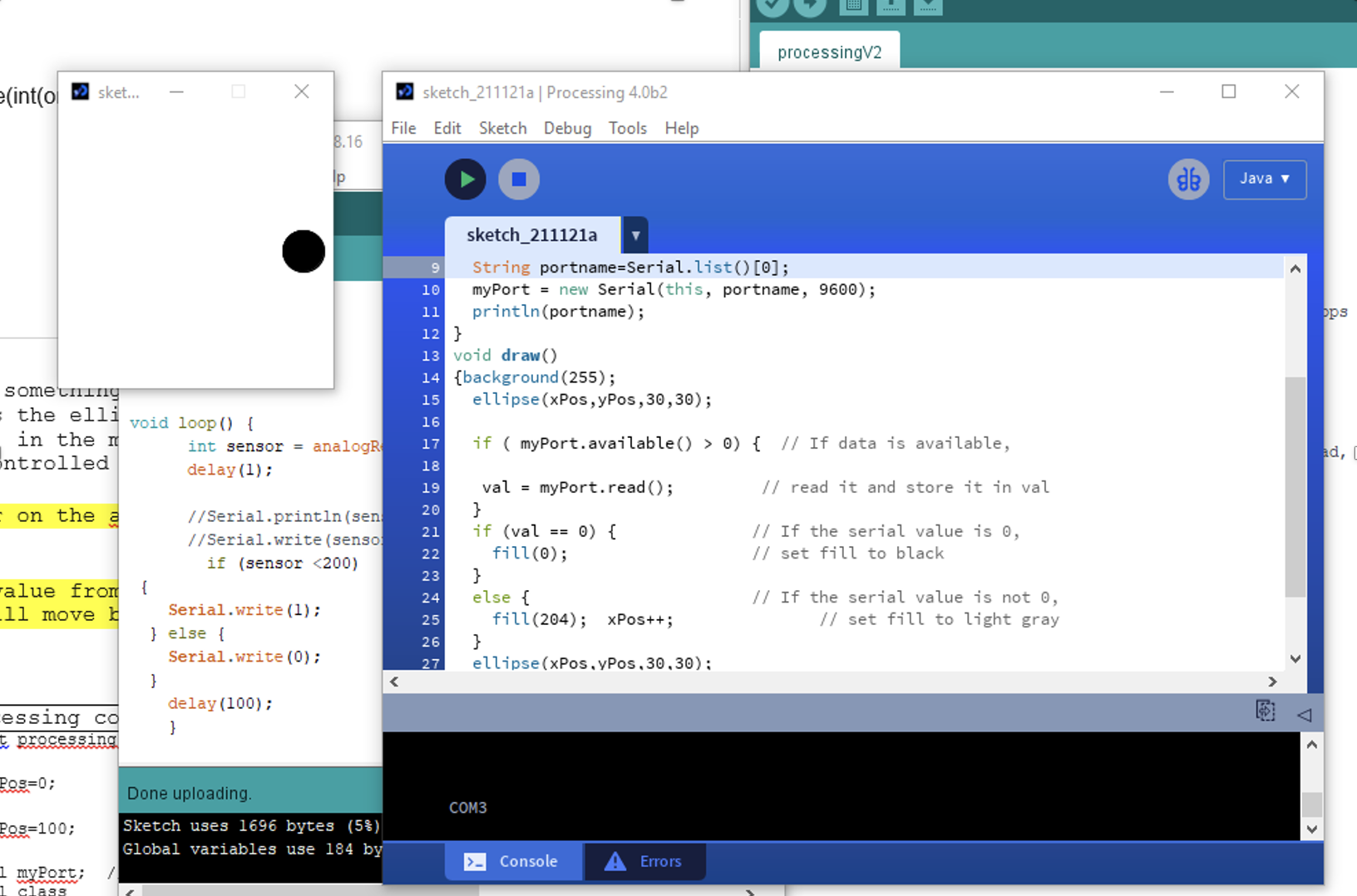
Procedure – The sensor on the Arduino Is the LDR, light depending on resistor. So, once the value from the LDR Arduino is less than 200, the ellipse will move by adding 1 to the Xposition.
Challenges- The difficulty was in working using both processing and Arduino together to be able to read from Arduino and control processing ellipse. By using myport to create an object from serial reading in processing , the problem was solved.
PROCESSING CODE :
import processing.serial.*;
int xPos=0;
int yPos=100;
Serial myPort;  // Create object from Serial class
int val;      // Data received from the serial port

void setup(){
  size(200, 200);
  String portname=Serial.list()[3];
  myPort = new Serial(this, portname, 9600);
  println(portname);
}
void draw()
{background(255);
  ellipse(xPos,yPos,30,30);

  if ( myPort.available() > 0) {  // If data is available,

   val = myPort.read();         // read it and store it in val
  }
  if (val == 0) {              // If the serial value is 0,
    fill(0);                   // set fill to black
  }
  else {                       // If the serial value is not 0,
    fill(204);  xPos++;               // set fill to light gray
  }
  ellipse(xPos,yPos,30,30);
}
ARDUINO CODE:
void setup() {
  Serial.begin(9600);

}

void loop() {
      int sensor = analogRead(A0);
      delay(1);

      //Serial.println(sensor);
      //Serial.write(sensor);
        if (sensor <200)
 {
    Serial.write(1);               // send 1 to Processing
  } else {
    Serial.write(0);               // send 0 to Processing
  }
    delay(100);
    }
OUTPUT :
EXERCISE 2 :
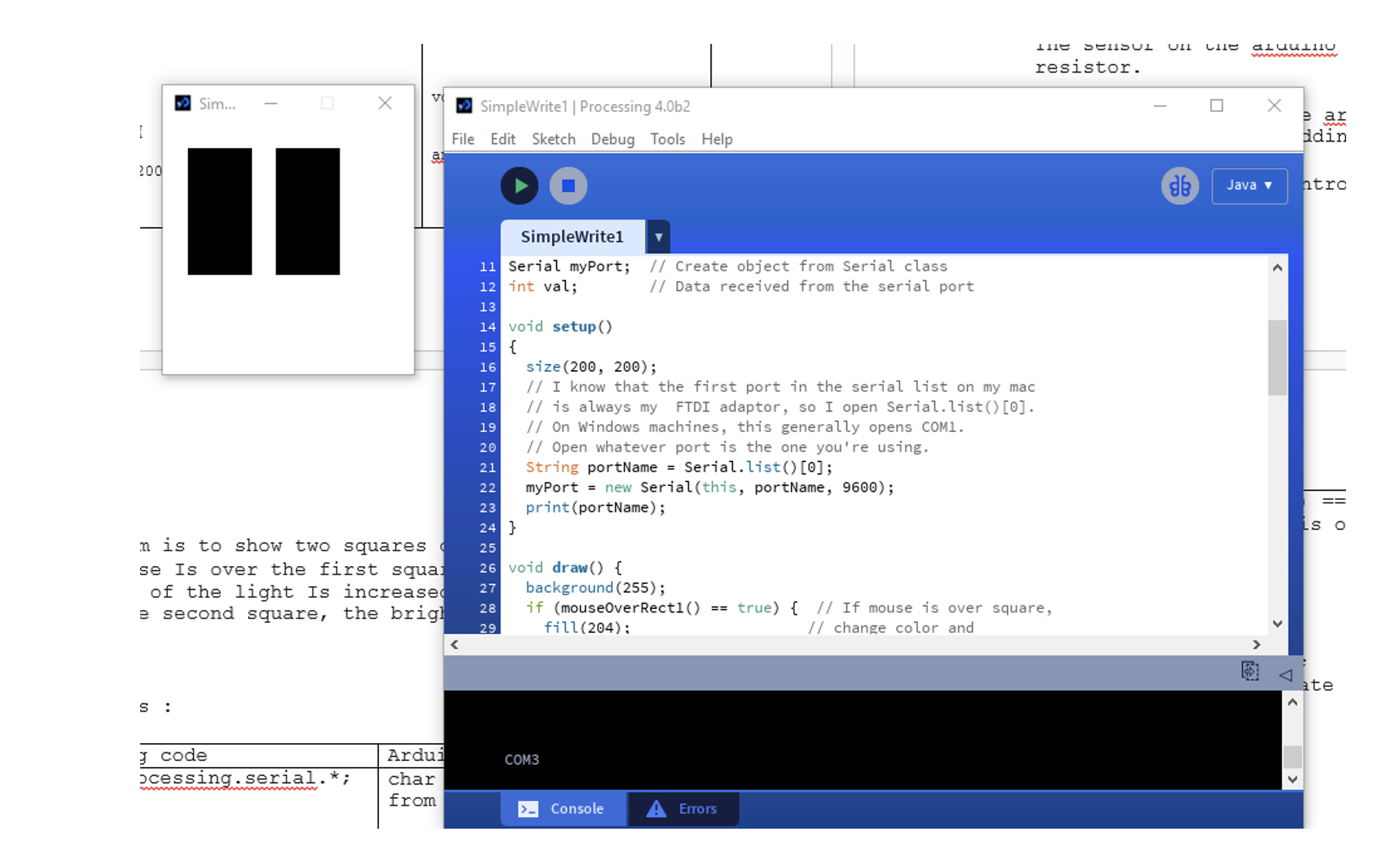
Procedure – The program is to show two rectangles on processing screen. If the mouse is over the first square on the left, the brightness of the light is increased by 1 and if the mouse is over the second square, the brightness is less by 1. The analogWrite(ledPin,i) is the command used for controlling the brightness of the led.
Challenges- The hardship was to connect the serial to write to the Arduino. By creating 2 different rectangles, we had two options for increasing and decreasing the brightness of the light.
PROCESSING CODE :
import processing.serial.*;

Serial myPort;  // Create object from Serial class
int val;        // Data received from the serial port

void setup()
{
  size(200, 200);
  String portName = Serial.list()[3];
  myPort = new Serial(this, portName, 9600);
  print(portName);
}

void draw() {
  background(255);
  if (mouseOverRect1() == true) {  // If mouse is over square,
    fill(204);                    // change color and
    myPort.write('H');              // send an H to indicate mouse is over square
  }
  else {                        // If mouse is not over square,
    fill(0);                      // change color and
    //myPort.write('L');              // send an L otherwise

  if (mouseOverRect2() == true) {  // If mouse is over square,
    fill(204);                    // change color and
    myPort.write('L');              // send an H to indicate mouse is over square
  }
  else {                        // If mouse is not over square,
    fill(0);                      // change color and
    //myPort.write('N');              // send an L otherwise
  }}
  rect(20, 20, 50, 100);         // Draw a square
  rect(90, 20, 50, 100);
}

boolean mouseOverRect1() { // Test if mouse is over square
  return ((mouseX >= 30) && (mouseX <= 70) && (mouseY >= 20) && (mouseY <= 120));
}
boolean mouseOverRect2() { // Test if mouse is over square
  return ((mouseX >= 90) && (mouseX <= 140) && (mouseY >= 20) && (mouseY <= 120));
}
ARDUINO CODE :
char val; // Data received from the serial port

int ledPin = 13; // Set the pin to digital I/O 4

int i = 10;

void setup() {

pinMode(ledPin, OUTPUT); // Set pin as OUTPUT

Serial.begin(9600); // Start serial communication at 9600 bps

}

 void loop() {

while (Serial.available()) { // If data is available to read,

val = Serial.read(); // read it and store it in val

if (val == 'H') { // If H was received
i++;
analogWrite(ledPin,i);

}
else if (val == 'L'){
i--;
analogWrite(ledPin,i); // Otherwise turn it OFF


}

delay(100); // Wait 100 milliseconds for next reading
}
}
OUTPUT :
EXERCISE 3 :
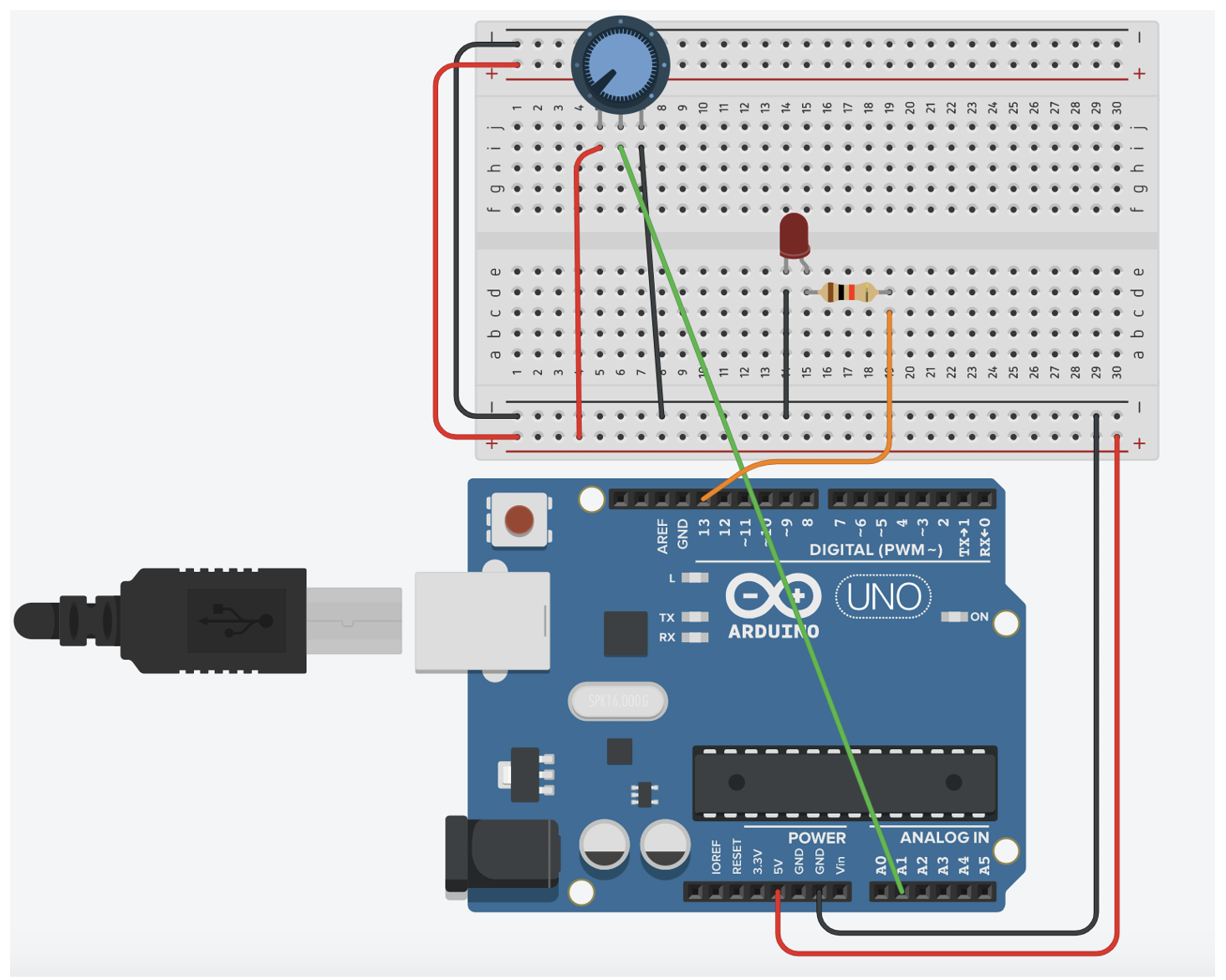
Procedure – The analog sensor used is the potentiometer on A1 analog port 1. If the value is less than 1024/2, the wind is blowing to the right. If the value is higher, then the wind is blowing to the left. Thus, the light turns on when the ball is bouncing.
Challenges- The challenge is to turn on the LED to have it on during the bouncing of the ball on processing screen. The second challenge was to use one analog sensor to make right and left movement, so our solution was to use a potentiometer that reads values from 0 to 1023. The mid value is the threshold, if under 1023/2, it moves to the right side, and if higher, moves to left side
PROCESSING CODE :
import processing.serial.*;

Serial myPort;  // Create object from Serial class
int val;
PVector velocity;
PVector gravity;
PVector position;
PVector acceleration;
PVector wind;
float drag = 0.99;
float mass = 50;
float hDampening;

void setup() {
  size(640,360);
  noFill();
  position = new PVector(width/2, 0);
  velocity = new PVector(0,0);
  acceleration = new PVector(0,0);
  gravity = new PVector(0, 0.5*mass);
  wind = new PVector(0,0);
  hDampening=map(mass,15,80,.98,.96);
  String portName = Serial.list()[3];
  myPort = new Serial(this, portName, 9600);
}

void draw() {
  background(255);
  //if (!keyPressed){
   // wind.x=0;
  //  velocity.x*=hDampening;
 // }
  applyForce(wind);
  applyForce(gravity);
  velocity.add(acceleration);
  velocity.mult(drag);
  position.add(velocity);
  acceleration.mult(0);
  ellipse(position.x,position.y,mass,mass);
  //
  if (position.y > height-mass/2) {
      velocity.y *= -0.9;  // A little dampening when hitting the bottom
      position.y = height-mass/2;
      myPort.write('L');
    }
    else myPort.write('H');

  if ( myPort.available() > 0) {  // If data is available,
    val = myPort.read();         // read it and store it in val
  }

     if(val==0){
    wind.x=-1;
  }

   else{
    wind.x=1;
  }
}

void applyForce(PVector force){
  // Newton's 2nd law: F = M * A
  // or A = F / M
  PVector f = PVector.div(force, mass);
  acceleration.add(f);
}

void keyPressed(){
  if (keyCode==LEFT){

    wind.x=-1;
  }
  if (keyCode==RIGHT){

    wind.x=1;
  }
  if (key==' '){
    mass=random(15,80);
    position.y=-mass;
    velocity.mult(0);
  }
}
ARDUINO CODE :
char val; // Data received from the serial port

int ledPin = 13; // Set the pin to digital I/O 4

int i = 50;
int left = 0;
int right = 0;
int rightbool=0;
void setup() {

pinMode(ledPin, OUTPUT); // Set pin as OUTPUT

Serial.begin(9600); // Start serial communication at 9600 bps

}

 void loop() {

while (Serial.available()) { // If data is available to read,

val = Serial.read(); // read it and store it in val

}

if (val == 'H') { // If H was received

digitalWrite(ledPin,HIGH);

} else {

digitalWrite(ledPin,LOW); // Otherwise turn it OFF

}
int sensor = analogRead(A1);
//Serial.println(sensor);
if(sensor<511){rightbool=1; Serial.write(1);}
else {rightbool=0;Serial.write(0);}

delay(100); // Wait 100 milliseconds for next reading

}
make something that uses only one sensor on arduino and makes the ellipse in processing move on the horizontal axis, in the middle of the screen, and nothing on arduino is controlled by processing
make something that controls the LED brightness from processing
take the gravity wind example
GIVEN CODE:
int left = 0;
int right = 0;

void setup() {
  Serial.begin(9600);
  Serial.println("0,0");
  pinMode(2, OUTPUT);
  pinMode(5, OUTPUT);
}

void loop() {
  while (Serial.available()) {
    right = Serial.parseInt();
    left = Serial.parseInt();
    if (Serial.read() == '\n') {
      digitalWrite(2, right);
      digitalWrite(5, left);
      int sensor = analogRead(A0);
      delay(1);
      int sensor2 = analogRead(A1);
      delay(1);
      Serial.print(sensor);
      Serial.print(',');
      Serial.println(sensor2);
    }
  }
}

/*

import processing.serial.*;
Serial myPort;
int xPos=0;
int yPos=0;
boolean onOff=false;
boolean onOff2=false;

void setup(){
  size(960,720);
  printArray(Serial.list());
  String portname=Serial.list()[1];
  println(portname);
  myPort = new Serial(this,portname,9600);
  myPort.clear();
  myPort.bufferUntil('\n');
}

void draw(){
  background(255);
  ellipse(xPos,yPos,30,30);
  if (mousePressed){
    if(mouseX<=width/2)
      onOff2=true;
    else
      onOff=true;
  }else{
    onOff=onOff2=false;
  }
}

void serialEvent(Serial myPort){
  String s=myPort.readStringUntil('\n');
  s=trim(s);
  if (s!=null){
    println(s);
    int values[]=int(split(s,','));
    if (values.length==2){
      xPos=(int)map(values[0],0,1023,0, width);
      yPos=(int)map(values[1],0,1023,0, height);
    }
  }
  myPort.write(int(onOff)+","+int(onOff2)+"\n");
}

 */
EXERCISE 1:
int left = 0;
int right = 0;

void setup() {
 Serial.begin(9600);
 Serial.println("0,0");
 pinMode(2, OUTPUT);
 pinMode(5, OUTPUT);
}

void loop() {
 while (Serial.available()) {
   right = Serial.parseInt();
   left = Serial.parseInt();
   if (Serial.read() == '\n') {
     digitalWrite(2, right);
     digitalWrite(5, left);
     int sensor = analogRead(A0);
     delay(1);
     int sensor2 = analogRead(A1);
     delay(1);
     Serial.print(sensor);
     Serial.print(',');
     Serial.println(sensor2);
   }
 }
}


//////////////////////////////////////////////////////

import processing.serial.*;
Serial myPort;
int xPos=0;
//int yPos=0;
boolean onOff=false;
boolean onOff2=false;

void setup(){
 size(960,720);
 printArray(Serial.list());
 String portname=Serial.list()[4];
 println(portname);
 myPort = new Serial(this,portname,9600);
 myPort.clear();
 myPort.bufferUntil('\n');
}

void draw(){
 background(255);
 ellipse(xPos,height/2,30,30);
 //if (mousePressed){
 //  if(mouseX<=width/2)
 //    onOff2=true;
 //  else
 //    onOff=true;
 //}else{
 //  onOff=onOff2=false;
 //}
}

void serialEvent(Serial myPort){
 String s=myPort.readStringUntil('\n');
 s=trim(s);
 if (s!=null){
   println(s);
   int values[]=int(split(s,','));
   if (values.length==2){
     xPos=(int)map(values[0],0,1023,0, width);
     //yPos=(int)map(values[1],0,1023,0, height);
   }
 }
 myPort.write(int(onOff)+","+int(onOff2)+"\n");
}